Broadcasters, streamers and technology vendors have been moving infrastructure, workflows and operations into cloud environments for more than a decade. A new analysis for the broadcast trade publication SVG Europe, written by Paul Markham, who writes a recurring column on cloud-native media operations there, argues that a substantial share of that movement was relocation rather than redesign: proprietary broadcast systems still sit at the centre of many architectures, workflows remain tightly coupled to vendor implementations, operational logic is embedded inside platform-specific tooling, and monitoring depends on proprietary telemetry frameworks.
Markham's case is operational. The commercial reading set out below is Voice Sport's own, and it turns on a date: the EU Data Act's cloud-switching and data portability obligations have applied since 12 September 2025, and its switching-charge provisions run to a second deadline in January 2027. European media organisations carrying multi-vendor cloud stacks are now operating inside a regime that may post-date many existing cloud and media-technology contracts.
What cloud migration actually delivered
Markham is explicit that the shift has delivered. Large-scale live streaming is now routine, pop-up channels launch in hours rather than months, and AI-assisted localisation, dynamic scaling and software-driven operations have become normal parts of media infrastructure. He is equally explicit that the hyperscalers are not the problem: "The hyperscalers themselves are not the issue," he writes, crediting their infrastructure and managed services with accelerating innovation across live production, localisation and large-scale streaming.
The problem he identifies is the default way organisations consume those platforms. "Cloud adoption alone does not change the operational model," Markham writes. The distinction he draws is between renting someone else's compute while keeping the same vendor-defined workflow logic, and retaining ownership of operational intent, workflow logic and data structures independently of whichever vendors sit underneath. It is not a call for vendor independence at any price: "The goal is not purity or total abstraction, but retaining enough operational ownership to preserve strategic flexibility," he writes, and he grants that "for many organisations, accepting a degree of dependency is an entirely rational trade-off."
What is actually inside the stack, and who owns which link
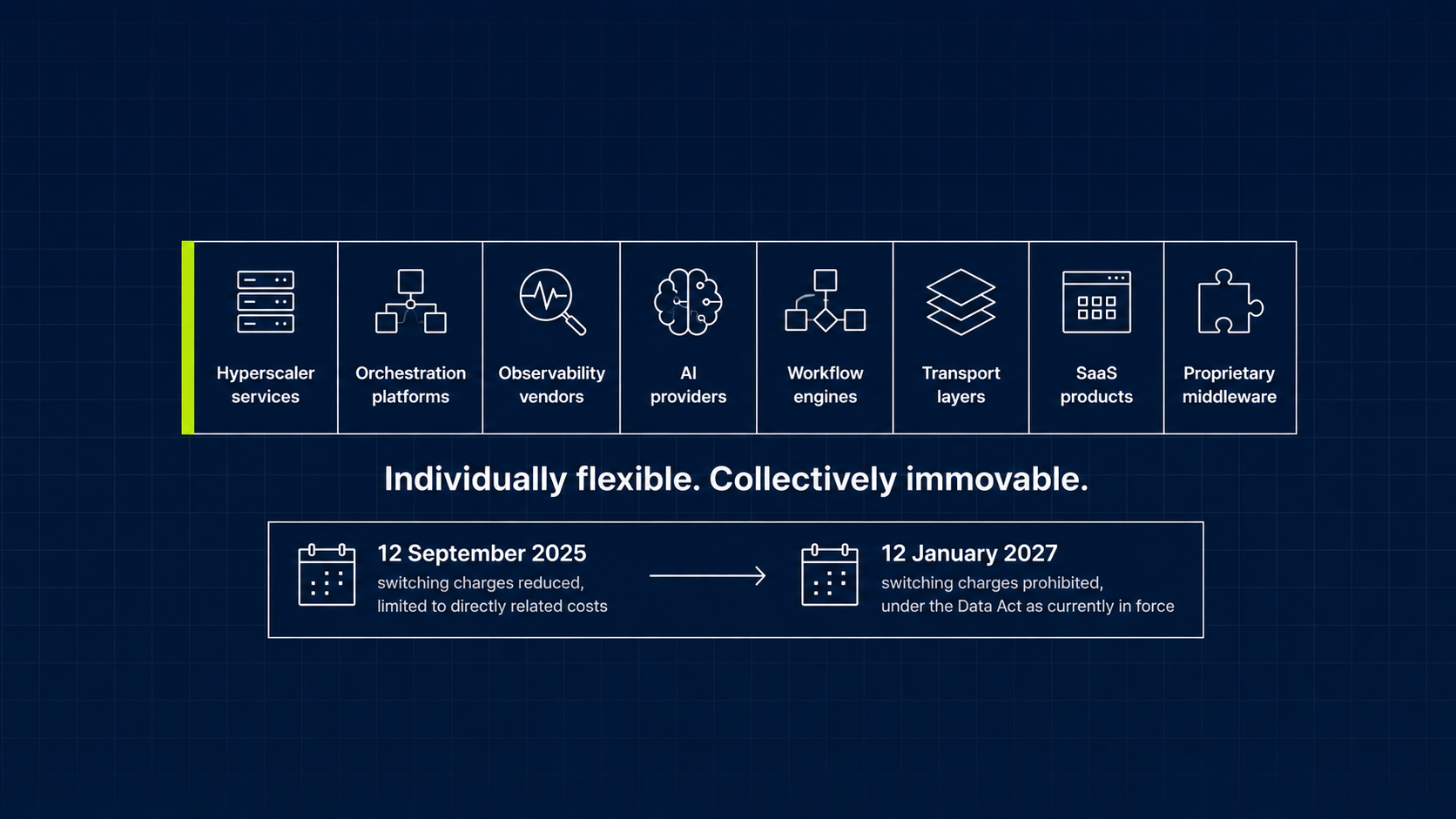
The article's central structural claim is that the dependency model has become multi-vendor rather than single-vendor, and that this can look healthier than it is. Rather than relying on one or two major broadcast suppliers, Markham writes, organisations "assemble complex ecosystems spanning hyperscaler services, orchestration platforms, observability vendors, AI providers, workflow engines, transport layers, SaaS products and proprietary middleware". Each platform brings its own APIs, telemetry models, orchestration logic and specialist knowledge requirements, and integration becomes a permanent engineering discipline in its own right.
"But simply increasing the number of suppliers does not automatically create openness," he writes. A workflow may technically span five or six vendors while remaining deeply locked into the combined behaviour of that ecosystem. Media workflows are unusually stateful, timing-sensitive and operationally interconnected, so practical migration becomes progressively harder once observability, orchestration, media transport and AI tooling are distributed across multiple tightly integrated platforms that evolve on independent release cycles.
Observability is where Markham locates the sharpest version of the problem. Infrastructure metrics may still look healthy, he writes, but understanding why a live workflow degraded, why SCTE signalling drifted, or why a multilingual audio chain failed becomes significantly harder once telemetry itself is fragmented across multiple vendor ecosystems. His framing of the underlying risk is not a commercial one: "The danger is not merely commercial dependency, but operational dependency created through accumulated complexity." Engineers, he argues, become experts in managing interactions between proprietary systems rather than in transferable operational models. "Cloud-native media was never supposed to mean assembling a larger collection of systems that are individually flexible but collectively immovable."
The commercial corollary is Voice Sport's, not Markham's: where a workflow spans several suppliers, each relationship carries its own contract and its own renewal timing, and a buyer that cannot establish where a failure originated is negotiating renewal terms without technical clarity about what it is actually buying.
What the EU Data Act's switching provisions do, and do not, cover
Regulation (EU) 2023/2854, the Data Act, entered into force on 11 January 2024 and became applicable on 12 September 2025 (dates per the European Commission's own Data Act policy page and the consolidated text). Chapter VI requires providers of data processing services, spanning infrastructure, platform and software-as-a-service offerings, to remove pre-commercial, commercial, technical, contractual and organisational obstacles to switching, and to support the portability of customer data and, in defined circumstances, digital assets.
The financial provisions run on their own timetable, and the scope is narrower than a general prohibition on exit costs: the regulation defines switching charges to include data egress charges but expressly excludes standard service fees and early-termination penalties from that definition, so ordinary contract-termination costs sit outside what follows. Under Article 29, providers may impose only reduced switching charges from the application date until 12 January 2027, and those charges may not exceed the costs the provider incurs directly in connection with the switching process concerned. From 12 January 2027, providers may impose no switching charges at all, under the Data Act as currently in force; the European Commission's Digital Omnibus process was still under legislative discussion as of mid-2026, so this article treats the 12 January 2027 date as the current legal position rather than a fixed certainty. This article does not impute how national competent authorities will enforce these provisions in any individual case, nor the outcome of any specific contractual renegotiation.
For an organisation carrying the kind of ecosystem Markham describes, that is a dated legal reference point that may post-date many current cloud contracts.
Whether the lever is usable depends on an earlier decision
Whether the Data Act's switching provisions are operationally usable is a separate question from whether they exist on paper. Markham's argument suggests the answer turns on a decision taken at the point of migration, often without being framed as a decision: whether workflow logic and data structures were defined independently of any single vendor's proprietary format, or inherited by default.
Markham points to open frameworks as the route to that separation, naming three: the European Broadcasting Union's Dynamic Media Facility (DMF), the DPP's LPX, and the Time Addressable Media Store (TAMS). Their long-term value, he writes, lies in attempting to separate media workflows from specific infrastructure providers and vendor implementations, treating media as observable and exchangeable entities that can move across environments while preserving operational continuity and metadata integrity.
The three are not directly comparable, since they solve different layers of the same problem (DMF is a facility-level reference architecture, TAMS is a storage and exchange API, LPX is a live-feed scheduling schema), and each leads on a different axis. On institutional governance, the DMF carries the most formal scaffolding of the three on the published record: joint governance involving EBU and AMWA, and a versioned, publicly released reference architecture. Per the EBU's own Technology & Innovation publications and DMF project page, the EBU held its DMF kick-off workshop in the first quarter of 2023 and published "The Dynamic Media Facility: Value Chain Transformation" white paper on 13 April 2023; the DMF Reference Architecture reached v1.0 in the third quarter of 2024 and v2.0 in the second quarter of 2026. On 13 September 2025 the EBU and the Advanced Media Workflow Association announced a Joint Task Force on Dynamic Media Facilities (JT-DMF), which held a two-day kick-off meeting in November 2025 bringing together EBU members, the AMWA community, vendors, end-users and systems integrators from Europe and North America. Its stated initial focus includes timing models for the Media eXchange Layer (MXL) open-source SDK, a business-level advisory council, and orchestration work drawing on AMWA's Networked Media Open Specifications. On the public implementation record reviewed by Voice Sport, TAMS currently shows several concrete vendor integrations: production integration announced in AWS Elemental MediaConvert in September 2025, publicly stated backing from Adobe, Sky and Reuters, and a multi-vendor demonstration at NAB 2026. Those are announcements by the vendors and adopters concerned rather than independently audited deployments, and they are read here as statements of intent and direction rather than as an independently verified ranking of the two frameworks. In January 2026, Markham reported that no major broadcast vendor was then shipping a fully MXL-native commercial product, with full multi-vendor MXL clusters in production not expected before 2027. EBU's current 2026 roadmap, by contrast, now records DMF-MXL V1 in early products and wider vendor interoperability testing as completed Q1 to Q2 milestones, so the January 2026 snapshot should not be read as the current state of MXL maturity.
What CBC's Olympic workflow PoC shows about the pace
Markham's own earlier reporting for SVG Europe, on the Canadian Broadcasting Corporation's workflow architecture for the Milano Cortina 2026 Winter Olympics, is useful precisely because it is not a demonstration of wholesale adoption. His 20 January 2026 piece, written before the Games, describes CBC/Radio-Canada as planning to apply DMF principles selectively, hybrid and partial by design: software-defined processing was to be introduced "where it delivers clear operational benefit" while existing infrastructure continued to function. On MXL specifically, he wrote at the time that it "should be understood as a direction of travel rather than a deployed component", with the organisation "applying DMF principles today, while planning to evolve towards MXL-based exchange as platforms and vendor support mature". EBU's current project page now records this as a completed proof of concept for select Cortina Olympic workflows at CBC, which confirms a PoC took place rather than a full Olympic-scale live deployment of DMF or MXL.
The comparison is structural rather than national. It does not indicate that European broadcasters lag North American ones; it indicates that even a well-resourced deployment at Olympic scale is proceeding component by component, on vendor-readiness timescales.
What this means for European rightsholders and federations
For sport organisations and broadcasters negotiating multi-year infrastructure and rights-adjacent technology deals, workflow architecture is not purely an engineering decision delegated to a technology team. It sets the commercial terms available at the next renewal. A federation or rightsholder that has not established which parts of its production and distribution workflow are portable, and which are bound to a single vendor's data format, will not know its own exit costs until it tries to leave.
The concrete sequence is short. Map which layers of the current stack hold workflow logic and which hold only execution. Establish, per contract, what the provider's switching obligations under Chapter VI now are and what charges remain permissible before 12 January 2027. Ask, before signing any renewal, whether observability data can move coherently to another environment, which is the question Markham puts to the sector directly.
Forward look
What remains genuinely uncertain is the pace of adoption. The JT-DMF is early: announced September 2025, first meeting November 2025. Open specifications of this kind have generally taken years rather than months to move from reference architecture to default procurement requirement, and the reasonable read is that the JT-DMF track should be tracked on that timescale rather than on an announcement-driven one. The Data Act's switching provisions give customers a dated legal reference point for testing exit costs, but a legal right to switch is not the same as an operationally straightforward switch, particularly for workflow logic that was never designed to be extracted. Whether Markham's platform argument becomes the sector's default posture or remains a minority discipline is the open question worth watching over the next 12 to 24 months.
Sources
- SVG Europe, "From infrastructure to platform: Where control actually matters," Paul Markham, 7 August 2026: https://www.svgeurope.org/blog/headlines/from-infrastructure-to-platform-where-control-actually-matters-2/
- SVG Europe, "Inside the EBU's Dynamic Media Facility: Why DMF and MXL matter for the next era of sports production," Paul Markham, 5 December 2025: https://www.svgeurope.org/blog/headlines/inside-the-ebus-dynamic-media-facility-why-dmf-and-mxl-matter-for-the-next-era-of-sports-production/
- SVG Europe, "From architecture to reality: What CBC's Milano Cortina 2026 workflows tell us about DMF and MXL in live sport," Paul Markham, 20 January 2026: https://www.svgeurope.org/blog/headlines/from-architecture-to-reality-what-cbcs-milano-cortina-2026-workflows-tell-us-about-dmf-and-mxl-in-live-sport/
- EBU Technology & Innovation, "The Dynamic Media Facility: Value Chain Transformation" white paper, 13 April 2023: https://tech.ebu.ch/publications/white-paper-2023-04-13
- EBU Technology & Innovation, "Dynamic Media Facility" project page (Reference Architecture v1.0 Q3 2024, v2.0 Q2 2026): https://tech.ebu.ch/groups/dmf
- EBU Technology & Innovation, "EBU and AMWA form Joint Task Force on Dynamic Media Facilities for transition to software-based media production," 13 September 2025: https://tech.ebu.ch/news/2025/09/ebu-and-amwa-form-joint-task-force-on-dynamic-media-facilities-for-transition-to-software-based-media-production
- AMWA, "AMWA and EBU Form JT-DMF: Joint Task Force on Dynamic Media Facility," 13 September 2025: https://www.amwa.tv/post/amwa-ebu-jt-dmf-dynamic-media-facility-task-force
- Regulation (EU) 2023/2854 (Data Act), consolidated text, Chapter VI and Article 29: https://eur-lex.europa.eu/eli/reg/2023/2854/oj/eng
- European Commission, Data Act policy page (entry into force 11 January 2024; application 12 September 2025): https://digital-strategy.ec.europa.eu/en/policies/data-act
- Morgan Lewis, "EU Data Act Begins September 12, Impacting Cloud Services, Connected Products, and Other Data Industries," 11 September 2025: https://www.morganlewis.com/blogs/sourcingatmorganlewis/2025/09/eu-data-act-begins-september-12-impacting-cloud-services-connected-products-and-other-data-industries