The EFC Foundation, the charitable arm of European Football Clubs, moderated a panel on youth mental health at United Nations headquarters in New York on 17 July 2026, two days before the FIFA World Cup final. Head of EFC Foundation Mike Pfister took the chair and used his introduction to present early findings from a mapping survey of the organisation's member clubs.
One classification point before anything else. This was not a UN conference of EFC's own making, and it was not a fringe side event either. It was a Football for the Goals panel sitting inside "One World, One Game, One Goal: Football as a Catalyst for Youth Mental Health and Well-Being", a full-day programme running from 10:00 to 18:00 at UN Headquarters, hosted by the UN Youth Office in partnership with the UN Member States Friends of Football as part of the Youth Office's flagship initiative on youth mental health and well-being. EFC's own headline calls it a UN conference; the accurate description is a panel inside a UN Youth Office event.
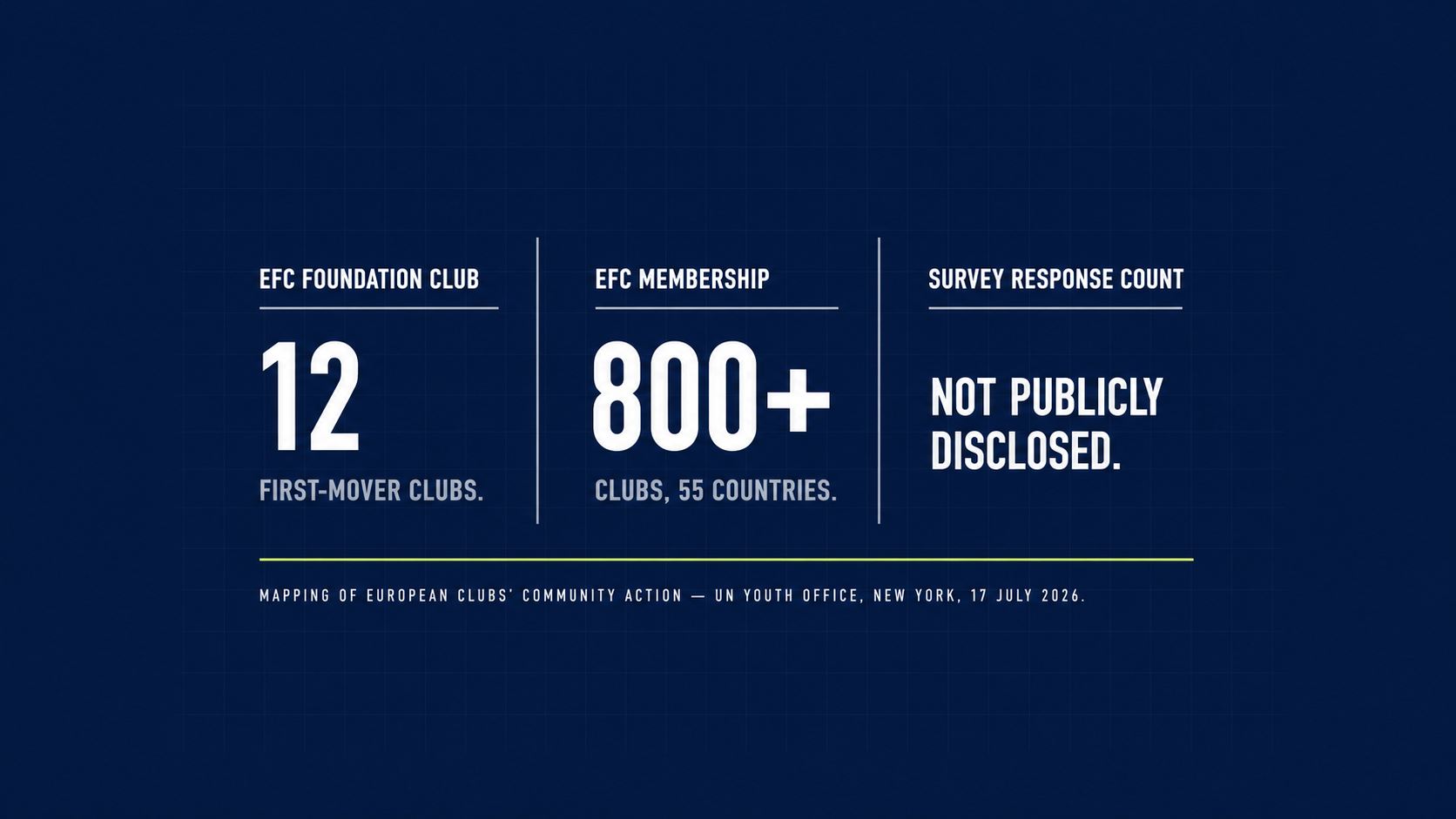
For club and league executives, the panel is the less consequential half of that sentence. Conference appearances by sport bodies are routine. What is not routine is a membership organisation representing more than 800 clubs beginning to record, systematically and across 55 countries, what its members' community programmes actually do.
One naming point, because it is easy to get wrong: the European Club Association's new identity as European Football Clubs, abbreviated EFC, took effect from 7 October 2025, unveiled the day before on the eve of its 32nd General Assembly in Rome. Same organisation, new name — formed in 2008, based in Nyon, Switzerland, recognised by both UEFA and FIFA as the sole independent body for clubs in Europe, and describing itself as the voice of more than 800 clubs from 55 countries and territories, of which more than 140 are women's clubs. ECA and EFC are not interchangeable labels for present-tense use: material published before October 2025 carries the ECA name, and the EFC Foundation is a distinct charitable entity from the membership body itself.
The Foundation's inaugural board met in December 2024
The Foundation held its inaugural board meeting in Budapest, announced by the then ECA on 3 December 2024, with Joe Cerrell, the Gates Foundation's Managing Director for Europe, the Middle East and East Asia in its Global Policy and Advocacy Division, joining the board. Its early work was relief-oriented: the concluded Ukrainian Relief Fund, earthquake contributions in Türkiye and Syria, wildfire relief in Greece, and a UNHCR partnership it committed to strengthening. Pfister is its inaugural Head of Foundation; his professional profile lists prior roles at the International Committee of the Red Cross, the OECD, the Basel Institute on Governance and FIFA.
Who was on the panel
EFC is an active member of Football for the Goals, the UN initiative launched on 6 July 2022, the opening day of UEFA Women's EURO 2022, with UEFA as its inaugural member. The initiative asks football's governing bodies, national associations, clubs, foundations, broadcasters and sponsors to commit to sustainability practices, SDG advocacy, a human-rights-based approach, equality and equity, and climate action.
Reduced to a name list the panel tells you little. The composition is the point.
Mike Pfister, Head of EFC Foundation — moderator, responsible for EFC's charitable arm and its co-ordination of member clubs' community work.
Robert Skinner, Chief of Partnerships and Global Engagement, United Nations — Deputy Director and Chief of Partnerships and Global Engagement in the Outreach Division of the UN Department of Global Communications, per his UN and professional profile. Also present at EFC's June roundtable with the Gates Foundation, making this a continuing relationship rather than a one-off booking.
Daniel Amokachi — former Nigeria international, listed among the Football for the Goals Champions on the UN's own roster, an informal ambassadorial role held by current and former players, coaches and media figures who raise awareness of the Sustainable Development Goals.
Samantha Richards, Street Child United — represented England at the 2018 Street Child World Cup and returned to UN Headquarters in July 2026 to present the declaration drawn up by the 28 teams at this year's Street Child World Cup in Oaxtepec, Mexico.
Eni Aluko — former Chelsea F.C. Women and England forward, and one of the Football for the Goals Champions named by the UN.
Amokachi is the participant EFC quoted. Referring to his own post-injury mental health experience, he said: "It gets lonely out there, even for former star players, and we all need to support each other."
The mapping survey is the substantive development
Pfister's framing was institutional rather than clinical. He said clubs "have great reach in their communities [and] are respected institutions that can use their influence and the power of football to help to tackle societal issues like the mental health challenge."
That claim is only as good as the evidence behind it, which is what the mapping is for. The initiative has a name — the Mapping of European Clubs' Community Action — and a structure: supported by the Gates Foundation, with delivery support from Substance, a UK consultancy specialising in social return on investment measurement in sport. EFC set the arrangement out at a roundtable it co-hosted with the Gates Foundation at the Gates Foundation's headquarters in Seattle, reported by EFC in late June 2026, where it also used the event to highlight the launch of the EFC Foundation Club, a first-movers coalition of 12 member clubs including Paris Saint-Germain, Feyenoord, Inter Milan, Brighton, Celtic and Real Betis. This coalition is not the mapping survey's sample and it is not a mental-health-specific group; it is a separate cohort of early-adopter clubs supporting the initiative's launch, drawn from a membership of more than 800. Chief executive Charlie Marshall made the data ambition explicit: "The EFC Foundation helps to tell the pan-European story on clubs' community impact and works with partners to connect globally."
The finding presented in New York is narrow and worth quoting precisely. EFC states that early findings from the mapping survey, "currently being undertaken, confirm that mental health is a key area of focus for many of our Member Clubs' community initiatives, with hundreds of EFC clubs delivering established programmes."
What has not been published
The public EFC materials reviewed do not disclose the survey instrument, the response rate, the number of clubs that have replied, the definition it applies to an "established programme", the category taxonomy, or a reporting date. That leaves open the possibility that a fuller methodology exists in member-only or not-yet-released form; nothing in this review confirms or rules that out. "Hundreds" is the only quantum offered, and it describes clubs running community programmes generally rather than mental-health programmes specifically. Until the methodology is in the open this is a stated direction of travel rather than a measurement — a normal position for a survey in progress, and the reason the panel appearance alone would not have justified attention.
What a national comparison shows
England and Wales have the closest thing to this dataset, and the contrast sets the scale of what EFC is attempting. The Premier League Foundation, renamed from the Premier League Charitable Fund on 17 November 2025, distributes around 34 million pounds a year to professional club charities across 106 club charities in the Premier League, EFL and National League. Official Premier League pages currently report approximately 7,400 to 7,500 people employed across that supported club-charity network, depending on which page and publication date is consulted. An independent study by the social research agency Substance — the same consultancy EFC has engaged for its mapping — found that every pound invested through the Foundation into community programmes generates 21 pounds in social value, and projected more than 4.3 billion pounds in social value across the 2025 to 2028 investment cycle.
Research on Premier League Kicks alumni carried out between October 2024 and August 2025 by the Centre for Social Justice in Sport and Society at Leeds Beckett University's Carnegie School of Sport found 98 per cent of respondents said the programme had improved their mental health and wellbeing. That is a self-reported perception figure from programme alumni, not a clinical outcome measure, and it should be read as such.
That is what a measured national programme produces: a funding architecture, a headcount, an outcome valuation and an evidence base public commissioners recognise. EFC describes its own initiative as the first Europe-wide mapping of club community impact of this kind, and this review did not identify a previously published dataset with the same membership-wide scope and purpose across European club football — though EFDN, UEFA and national leagues have each published social-impact or community-programme research with different scope, so the field is not empty, only not yet mapped at this scale and breadth.
The UN's frame here is SDG 3 on good health and wellbeing. The World Health Organization's adolescent mental health fact sheet, updated 1 September 2025, records that one in seven 10 to 19-year-olds globally, or 14.3 per cent, experiences a mental health condition, accounting for 15 per cent of the global burden of disease in that age group, and that these conditions remain largely unrecognised and untreated. That is a global figure for a global age cohort; it is not a European figure and it is not a figure about club programme participants. Clubs are not clinical providers and neither EFC nor the UN Youth Office has suggested otherwise. The relevance is narrower: a documented service gap is one that organisations with community reach are being asked to help address, and reach is the asset club foundations hold.
What this means for club foundations and CSR leads
Mental health may become a reportable category. If the mapping publishes its taxonomy, "mental health and wellbeing" stops being an activity folded into general community work and becomes a line counted across Europe. Foundations that cannot separate it in their own reporting would be under-represented in a first pan-European picture of the sector.
Substance brings established SROI expertise, but EFC has not publicly confirmed the mapping's methodology. Substance's involvement in both the EFC mapping and the Premier League Foundation's social value study makes social return on investment a plausible measurement frame for the comparison, not a confirmed one. Voice Sport editorial reading: foundations that get ahead of an eventual shift from participation counts to outcome valuation will be better placed once a first report lands, whatever methodology EFC ultimately publishes.
Comparability cuts both ways. Voice Sport editorial reading: a pan-European baseline could strengthen the case for club foundations in Erasmus+ Sport and EU health-policy funding, where the absence of comparable European evidence has been a standing weakness; EFC has not stated this as an objective of the mapping. It is also demanding for clubs whose community reporting has never been benchmarked against peers.
The next data point to watch is not another panel. It is whether EFC publishes the mapping methodology, the response rate and a reporting date. This article does not impute whether it will. If those three appear, European club football acquires its first shared measure of community delivery. If they do not, the survey remains an internal management tool and the sector continues to argue about impact without a common denominator.
Sources
Primary source
- European Football Clubs, "EFC Foundation puts youth mental health centre stage at UN conference in New York", 21 July 2026 (panel moderation, Football for the Goals framing, Pfister and Amokachi quotes, early mapping findings) — https://www.efcfootball.com/en/news/efc-foundation-puts-youth-mental-health-centre-stage-at-un-conference-in-new-york
Supporting reporting
- European Football Clubs, "EFC Foundation plays key role in 'Beyond the Game: Sport for a Healthier Future' event", late June 2026 (Seattle roundtable, Mapping of European Clubs' Community Action, Gates Foundation support, Substance partnership, EFC Foundation Club coalition of 12 clubs, Charlie Marshall quote, Joe Cerrell role, Robert Skinner title) — https://www.efcfootball.com/en/news/efc-foundation-plays-key-role-in-beyond-the-game-sport-for-a-healthier-future-event
- European Football Clubs, "ECA Board concludes 2024 with focus on strategic priorities for 2025 and beyond", 3 December 2024 (inaugural Foundation board meeting in Budapest, Cerrell board appointment, Ukrainian Relief Fund, Türkiye-Syria earthquake and Greece wildfire relief, UNHCR partnership) — https://www.efcfootball.com/en/news/eca-board-concludes-2024-with-focus-on-strategic-priorities-for-2025-and-beyond
Institutional context
- European Football Clubs, "About EFC" (recognition by UEFA and FIFA as the sole independent body for clubs in Europe, membership exceeding 800 clubs across UEFA's 55 national associations, formation 2008) — https://www.efcfootball.com/en/about-us
- European Football Clubs, "Who We Are" (more than 800 clubs across 55 countries and territories) — https://www.efcfootball.com/en/who-we-are
- European Football Clubs, "We are EFC", 6 October 2025 (rebrand unveiled on the eve of the 32nd General Assembly in Rome) — https://www.efcfootball.com/en/news/we-are-efc
- European Football Clubs, "Our Brand" (name in effect from 7 October 2025) — https://www.efcfootball.com/en/who-we-are/our-brand
- European Football Clubs homepage (140+ women's member clubs) — https://www.efcfootball.com/en
- United Nations Youth Office, "One World, One Game, One Goal: Football as a Catalyst for Youth Mental Health and Well-Being", 17 July 2026, 10:00 to 18:00, UN Headquarters, hosted with the UN Member States Friends of Football, framed under Sustainable Development Goal 3 on good health and wellbeing — https://www.un.org/youthaffairs/en/17-July-2026
- United Nations, Football for the Goals initiative and member commitments — https://www.un.org/en/footballforthegoals
- UN News, "UN and UEFA score Sustainable Goals as women's Euro tournament kicks off", 6 July 2022 (initiative launched on the opening day of UEFA Women's EURO 2022, UEFA the first organisation to join) — https://news.un.org/en/story/2022/07/1122002
- UN News, "Khalida Popal and Javier Zanetti among football stars appointed UN Champions", 24 May 2026 (16 Football for the Goals Champions, informal ambassadorial role, Eni Aluko named) — https://news.un.org/en/story/2026/05/1167582
- United Nations, Football for the Goals Champions roster (Daniel "The Bull" Amokachi and Eni Aluko both listed; roster now exceeds the initial group of 16) — https://www.un.org/en/football-goals/football-goals-champions
- United Nations, Football for the Goals profile, Daniel Amokachi — https://www.un.org/en/football-goals-new/daniel-amokachi
- United Nations, Football for the Goals profile, Eni Aluko — https://www.un.org/en/football-goals-new/eni-aluko
- Wikipedia, "Daniel Amokachi" (44 Nigeria caps, 1994 Africa Cup of Nations, 1996 Olympic gold, 1995 FA Cup with Everton) — https://en.wikipedia.org/wiki/Daniel_Amokachi
- Wikipedia, "Eni Aluko" (Chelsea and England career, Juventus, Women's Super League and Serie A honours) — https://en.wikipedia.org/wiki/Eni_Aluko
- Wikipedia, "European Football Clubs" (headquarters in Nyon, Switzerland; institutional history) — https://en.wikipedia.org/wiki/European_Football_Clubs
- Street Child United, "We Are All Somebody", 24 February 2021 (Samantha compiling the voices of street-connected young people into a book of poetry and artwork; represented England at the 2018 Street Child World Cup in Moscow) — https://streetchildunited.org/news/we-are-all-somebody/
- UN News, "'I am somebody': Street-smart youth take their declaration to the UN", 25 July 2026 (Samantha Richards named in full, described as a Street Child United alumna; 28 teams competed at the Street Child World Cup in Oaxtepec, Mexico, where the declaration was drafted). The article dates her Hall of Flags appearance only as "last week", so no specific day is asserted here — https://news.un.org/en/story/2026/07/1168015
- Gates Foundation, leadership profile, Joe Cerrell (Managing Director, Europe, Middle East, and East Asia, Global Policy and Advocacy Division) — https://www.gatesfoundation.org/about/leadership/joe-cerrell
Sector context
- Premier League Foundation, "About Us" (around 34 million pounds distributed annually, more than 7,400 people employed across 106 club charities in the Premier League, EFL and National League) — https://www.premierleague.com/en/footballandcommunity/morethanagame/premier-league-foundation/about-us
- Premier League, "In numbers: Premier League's support for communities", 12 March 2026 (21 pounds of social value per pound invested, 4.3 billion pounds projected across the 2025 to 2028 cycle, independent study by Substance; this release gives a figure of more than 7,500 people employed, against the "About Us" page's more than 7,400 — the source of the range cited in the body) — https://www.premierleague.com/en/news/4237127/in-numbers-the-premier-leagues-support-for-communities
- Premier League, "Premier League's official charity celebrates 15 years of community impact", 17 November 2025 (renaming from Premier League Charitable Fund) — https://www.premierleague.com/en/news/4462271/premier-league-foundation-celebrates-15-years
- Premier League, "Premier League Foundation: Transforming lives across England and Wales", 17 November 2025 (England and Wales scope of the club charity network) — https://www.premierleague.com/en/news/4450424/premier-league-foundation-timeline
- Premier League Foundation, "Our Impact" (Premier League Kicks alumni research October 2024 to August 2025 by the Centre for Social Justice in Sport and Society, Carnegie School of Sport, Leeds Beckett University) — https://www.premierleague.com/en/footballandcommunity/morethanagame/premier-league-foundation/our-impact
- World Health Organization, "Mental health of adolescents" fact sheet, updated 1 September 2025 (one in seven 10 to 19-year-olds globally at 14.3 per cent, 15 per cent of the global burden of disease in that age group) — https://www.who.int/news-room/fact-sheets/detail/adolescent-mental-health
- European Non-Governmental Sports Organisation Network / EFDN, published social-impact and community-programme research (cited to support the statement that other organisations have published work in this space, with different scope from EFC's mapping) — https://www.efdn.org/wp-content/uploads/2017/02/NC0116017ENN_002.pdf
Verification note: the six efcfootball.com URLs above are client-rendered Next.js pages. Automated fetches and RAG loaders return navigation chrome only, or fail outright; the article body is served inside the page's embedded content payload. Pass 1 recorded four of them as failed uploads and the remaining two as chrome. Pass 2 uploaded all sources successfully and still could not read any of the three EFC press releases, reporting them as absent from its context: upload success and text extraction are separate problems on this domain. Downstream verification should expect an extraction failure on these six, not a content mismatch, and should treat the EFC facts as manually primary-verified against the embedded payload. The EFC news listing shows the primary source dated 21 July 2026; this article was corrected from 22 July 2026 accordingly. The same applies to the un.org event and profile pages. Where those carry load-bearing facts, a loadable corroborating source has been added alongside them: the Football for the Goals Champions roster for the Amokachi and Aluko designations, and the EFC homepage, whose card image for the June release carries the alt text "Seattle", independently corroborating the roundtable venue.
Accepted sourcing limitation: the prior roles listed for Mike Pfister and the departmental sub-division given for Robert Skinner rest on their professional profiles, which no automated loader can reach. Both are hedged in the body as profile-sourced rather than stated as institutional fact. No unloadable profile URL has been added to this block, so that the source count reflects what a verifier can actually read.