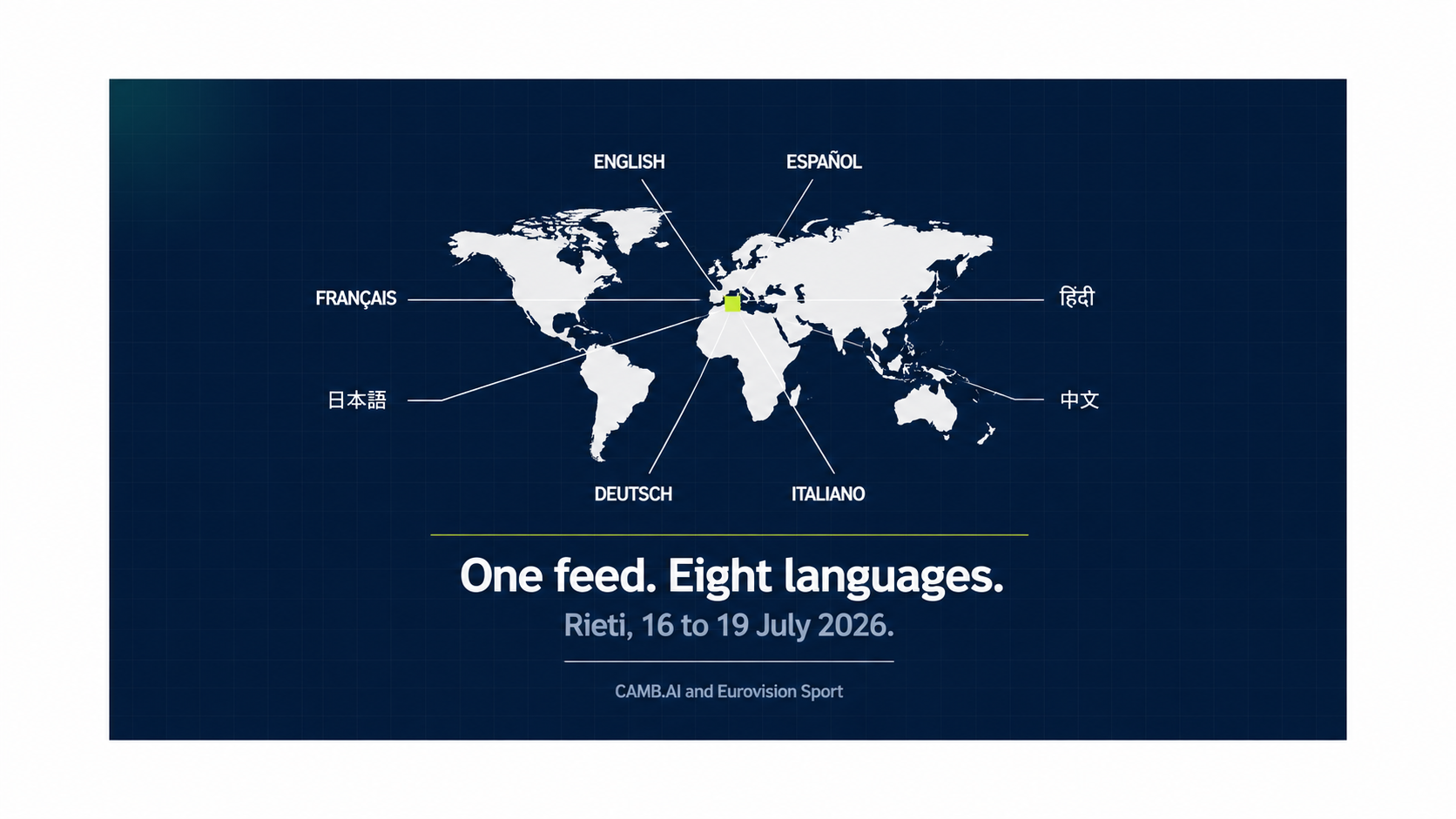
Beginning 16 July at Stadio Raul Guidobaldi in Rieti, Italy, Eurovision Sport says it will offer the European Athletics U18 Championships with commentary available in Dutch, German, Hindi, Japanese, Mandarin, Portuguese, Serbian and Spanish.
Per the EBU press release, none of those eight language feeds will have a human commentator behind them. They are to be generated in real time by AI, translated from a French-language remote commentary feed, and delivered through Eurovision Sport's free streaming platform. All content will be labelled as AI-generated.
The technology is not new. The scale of this particular deployment is what matters.
---
European Sport's Language Problem
European sport has always had an audience geography problem that its American counterpart has largely avoided. The NFL broadcasts into a market with one dominant language. European football, athletics, cycling and racquet sports broadcast into a continent with 24 official EU languages, and, when seeking global audiences, into dozens more.
The cost structure of commentary has historically constrained how far European sport content travels. Language-specific commentary for a niche event requires a human commentator with relevant sport knowledge in that language. Voice Sport editorial reading: that cost structure has generally made it commercially unrealistic to commission Mandarin-language commentary for an event like the European Athletics U18 Championships, though the precise cost curve for any given federation depends on its own commissioning model.
Rieti is a test of whether that constraint is loosening.
---
What CAMB.AI's System Actually Does, and What It Has Already Done
Eurovision Sport's technology partner for this deployment is CAMB.AI. The partnership has a track record that predates Rieti: in 2024, Eurovision Sport and CAMB.AI used live AI-generated translated commentary, from French into Portuguese, at the World Athletics U20 Championships, and the partners have since tested the approach at other European Aquatics and European Athletics events. CAMB.AI also provided live and on-demand AI subtitling for the Milano Cortina 2026 Paralympic Winter Games, a related but distinct product (subtitling rather than spoken commentary).
Rieti is not a first proof of concept. It expands the existing Eurovision Sport–CAMB.AI model from single-language and trial deployments to eight translated language feeds at one event.
Per the EBU press release, the system takes a French-language remote commentary feed, covering the action from outside the stadium, and translates it in real time into the eight target languages. The translation layer handles both the linguistic conversion and the voice synthesis, producing commentary that is delivered through Eurovision Sport's free streaming platform and labelled to viewers as AI-generated.
The technical challenge that systems like this face in live commentary is specific: sport language is fast, compressed, and heavily dependent on real-time context. A commentator describing a sprint final produces a burst of high-emotion, abbreviated language within a three-to-five-second window. The AI translation must resolve that in time for the viewer to receive it synchronously with the visual action they are watching. Whether it does so reliably across eight structurally different languages simultaneously is the open technical question Rieti will help answer.
---
The Economics of Audience Reach
Voice Sport editorial reading: if the system proves reliable across eight languages at once, it could ease part of the cost constraint described above, making it commercially viable to test additional language feeds for events that could not otherwise justify commissioning dedicated commentary teams. That is a narrower claim than saying the technology eliminates localisation costs. AI translation and voice synthesis do not remove the licensing, quality-control, editorial oversight, and technical integration costs that a live multilingual deployment still requires, and none of those costs have been quantified in the public sources reviewed.
Voice Sport editorial reading: if this model is adopted more widely, it may over time affect how digital rights packages structured around territory and language are valued, since some of that structure has historically reflected commentary production costs. Whether and how quickly that happens is not something the public record currently supports predicting.
---
Transparency and Credibility
The decision by Eurovision Sport and European Athletics to clearly label all AI-generated commentary is worth noting explicitly.
The broadcast sports industry has been working through how to handle AI-generated content in a live context. One position holds that audiences do not care about the production method if the result is quality commentary that enhances their experience. Another holds that the labelling obligation exists because the relationship between commentary and human expertise in sport is part of the product's value proposition.
Eurovision Sport chose the transparency route. Per European Athletics positions on the deployment, every viewer watching the Rieti feed in any of the eight AI-translated languages is intended to know they are receiving AI commentary.
That choice addresses the most direct credibility challenge: a future controversy about whether AI commentary was used without disclosure. The labelling decision is documented; it is a factual element of how the deployment was designed and communicated.
Separately, EU-level transparency rules for AI-generated content are already defined and become applicable from 2 August 2026, under the AI Act's Article 50 transparency obligations. How those detailed requirements apply to live translated sports commentary specifically has not yet been tested, and would require a system-specific legal assessment rather than a general assumption either way.
---
Birmingham and Beyond
Subject to final operational approval, Eurovision Sport and European Athletics expect to use the technology again during selected field event finals at the European Athletics Championships in Birmingham in August 2026. Public sources confirm this scope — selected finals, not a full championship-wide deployment — and the operational approval is not yet finalised.
Whether the partners choose to expand beyond that scope, at Birmingham or at future events, is not yet public.
---
What European Sport Executives Should Watch
The immediate question is whether the Rieti performance data — quality ratings, audience reaction, technical stability — will be shared publicly by Eurovision Sport and European Athletics. If it is, it will inform adoption conversations at other federations and rights holders. If it is not, those conversations will happen more slowly and with less evidence to go on.
Voice Sport editorial reading: over some future period, cycling, swimming, and gymnastics could plausibly be candidates for similar deployments, given a broadly comparable structural profile (technically specialised content, European institutional governance, and audiences without language-appropriate access), but no specific pilot has been announced in the sources reviewed and no timeframe should be inferred from this comparison.
The regulatory question is one to watch rather than one that is resolved. EU-level transparency rules for AI-generated content become applicable from 2 August 2026. How labelling obligations, quality standards, and commercial rights terms apply in detail to AI-translated live sports commentary is likely to be worked out through practice and, potentially, specific legal assessment, alongside whatever broader regulatory attention the sector attracts.
---
Sources
Primary source: EBU, "Eurovision Sport launches multilingual AI commentary for European Athletics U18 Championships," July 2026. ebu.ch/news/2026/07/eurovision-sport-and-european-athletics-bring-live-athletics-to-more-fans-with-multilingual-ai-commentary-initiative
Technology context and prior deployments: - EBU, "Eurovision Sport and CAMB.AI create history with Europe's first AI-powered real-time translated commentary" (2024 World Athletics U20 Championships). ebu.ch/news/2024/08/eurovision-sport-and-camb-ai-create-history-with-europe-s-first-ai-powered-real-time-translated-commentary - EBU, "Eurovision Sport and CAMB.AI to provide live and on-demand subtitling for Milano Cortina 2026 Paralympic Winter Games," March 2026. ebu.ch/news/2026/03/eurovision-sport-and-camb-ai-to-provide-live-and-on-demand-subtitling-for-milano-cortina-2026-paralympic-winter-games
Regulatory context: European Commission, Digital Strategy, "Code of Practice on Transparency of AI-Generated Content"; AI Act Article 50 transparency obligations, applicable from 2 August 2026.
Event context: European Athletics U18 Championships 2026, Rieti, Italy, 16 to 19 July. eurovisionsport.com; european-athletics.com