The Nederlandse Boksbond and NOCNSF have introduced "Assistent Trainer Boksen 1" (TC1), a new entry-level coaching qualification that combines NOCNSF's generic "Sterk van start" e-learning module with a single in-person practical session. The federation adapted the module with boxing-specific examples, images and practice situations, then ran its first practical meeting in June at Boxing Club Deurne, drawing participants from as far apart as Leeuwarden and Vlissingen. The qualification sits within the Kwalificatiestructuur Sport (KSS), described in the announcement as the national quality standard of the Dutch sport sector, and is intended to make the first step into boxing coaching more accessible.
What is the Assistent Trainer Boksen 1 qualification?
TC1 is the foundational tier of the Nederlandse Boksbond's trainer-coach pathway. It is built on "Sterk van start", a sport-generic e-learning module that NOCNSF, the Dutch Olympic CommitteeDutch Sports Federation and umbrella body for organised sport in the Netherlands, makes available to its affiliated national governing bodies as a shared foundation for entry-level coach training. The Nederlandse Boksbond customised the generic module with boxing-specific scenarios and examples, then added a physical practical session to complete the qualification. NOCNSF, which comprises 77 national governing bodies including the Nederlandse Boksbond, alongside 17 associated organisations, positions the module as part of its broader "Bekwaam sportkader" (competent sports staff) programme area, which frames trainer-coach quality as a direct influence on participants' enjoyment of sport. The announcement also links the new basic training to the "vier V's voor veiligheid", the four safeguarding principles NOCNSF works on with federations and municipalities under Nederland Sport Veilig, placing the qualification inside the safe-sport-environment agenda rather than treating it as technical instruction alone.
The Atletiekunie, the Dutch athletics federation, runs its own level 2 trainer courses (Assistent Looptrainer 2 for running and Baanatletiektrainer 2 for track and field athletics) on a comparable blended model: five physical sessions combining theory and practice, an e-learning component, and supervised practical delivery at the participant's own club. This is a separate Dutch example of blended trainer education. The reviewed source does not show that Atletiekunie's e-learning component is built on NOCNSF's "Sterk van start" module specifically, nor when its current format was introduced, so it is noted here as a domestic comparator rather than evidence that NOCNSF's specific module is spreading across federations.
Why did the Nederlandse Boksbond and Boxing Club Deurne need it?
The case for the qualification is illustrated by a single club rather than a national statistic. Boxing Club Deurne, with 120 members and only two qualified trainers, had reached the limits of its coaching capacity. John Bersch, a board member of the Nederlandse Boksbond and chairman and head coach of Boxing Club Deurne, described the underlying problem in the primary announcement: "Veel boksclubs hebben behoefte aan didactisch en pedagogisch goed onderlegde trainers" ("Many boxing clubs need trainers with strong didactic and pedagogical grounding"). That is a federation board member's characterisation of a wider need across boxing clubs, not a published national count of vacant coaching posts; the reporting reviewed for this article does not carry a Netherlands-wide trainer shortage figure.
What the reporting documents at club level is more specific than a blanket claim that all five came through TC1. Boxing Club Deurne now reports five new assistant trainers; the announcement specifically identifies Sarah van den Broek as a member of the first TC1 cohort who completed the qualification, but does not state as clearly that all five went through the new pathway rather than, for some, an earlier club-run basic course. The announcement records that she has stood in front of the group with more confidence since finishing the course. Her own account of the training gap the qualification tries to close is specific: "Het geven van een training gaat verder dan het beheersen van de bokstechniek" ("Coaching a training session goes further than mastering boxing technique"). She also noted that while all trainers at the club work from the same structure, "iedere trainer geeft daar zijn eigen invulling aan" ("every trainer puts their own stamp on it"), a reminder that the qualification is meant to standardise pedagogical grounding, not coaching style.
Is a blended e-learning-and-practical coaching pathway becoming more common across Europe?
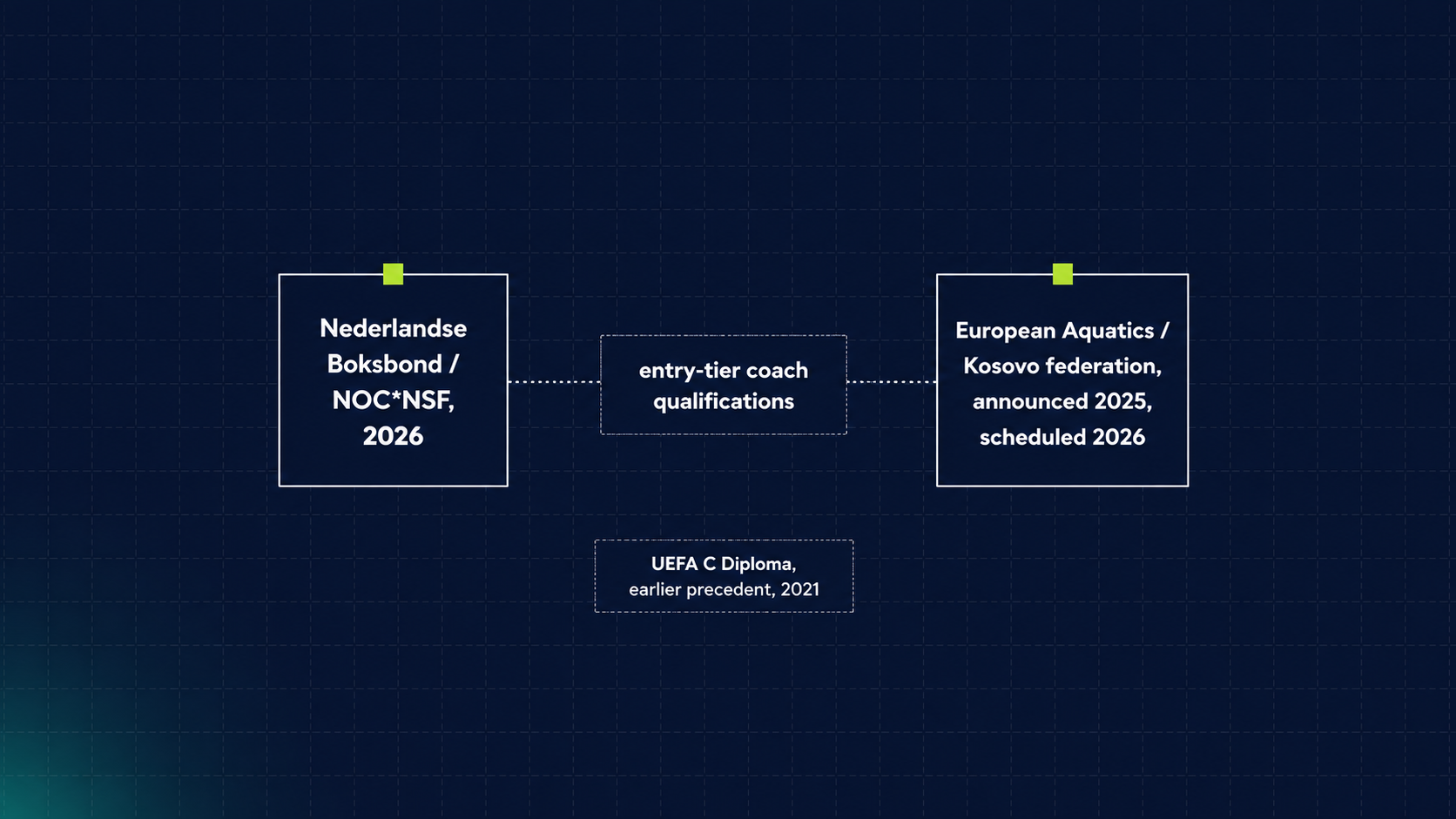
One recent, closely comparable case sits alongside the Dutch boxing announcement. European Aquatics announced its first-ever Level 1 Swimming Coaches' Course on 27 December 2025, commissioned by Kosovo's national aquatics federation and developed with Special Olympics Europe-Eurasia, with an online component scheduled for January 2026 and in-person sessions scheduled for February 2026. This research did not identify a later primary source confirming the course was delivered as scheduled, so it is described here as announced and scheduled, not as completed. European Aquatics said it would roll out similar blended courses across other aquatic disciplines in the first half of 2026, and reported that around 30 national federations had already requested formal recognition of the certification process, with applications open until 2027; that figure describes federations seeking recognition, not federations that have run the course.
UEFA offers a related but older comparator on objective rather than on timing or design. Its C Diploma for grassroots coaches launched in April 2021, aimed at increasing both the quantity and the quality of coaches at entry level, and national associations have been rolling it into their own coaching pathways since. UEFA's 2025 Coaching Convention update associates further work on coach numbers and representation with the same broader programme, but the C Diploma itself is not a 2025 or 2026 announcement, and UEFA's published material on it does not describe a blended e-learning-plus-practical format. It should not be read as part of the same current sequence as the Dutch boxing and European Aquatics cases.
That leaves one firmly dated, cross-border case, European Aquatics' Kosovo course, matching the Dutch boxing case on design as well as broad intent, and one older case, UEFA's C Diploma, matching only on the general objective of growing grassroots coach numbers. Two recent cases is not enough to describe a settled trend across European sport. Voice Sport editorial reading: the Dutch boxing qualification and the European Aquatics announcement are worth tracking as an emerging pattern that the next instance may or may not confirm, but they are not yet evidence of a Europe-wide shift, and UEFA's 2021 diploma should not be cited as part of the same current wave.
What this means for federations and grassroots coach networks
For federation education leads, the practical takeaway is less about boxing specifically and more about a design pattern worth testing against a federation's own numbers: pairing a generic, centrally supplied e-learning module with a short, local practical session appears to lower the friction of the first coaching qualification without requiring a federation to build bespoke online content from scratch. Voice Sport editorial reading: for federations that already sit inside a national umbrella body with a shared e-learning platform, such as NOC*NSF's "Sterk van start" in the Netherlands, reusing that shared foundation may reduce the amount of sport-specific content a federation needs to develop from scratch, although the public sources reviewed provide no cost or time comparison to support a specific claim about how much lower the marginal cost is.
For Erasmus+ Sport project managers and grassroots networks tracking coach-capacity funding lines, European Aquatics' continental rollout plan is the more directly transferable comparator, since it involves a continental federation designing a framework intended for adoption across many national associations rather than a single federation's internal fix.
What remains uncertain
The reporting reviewed does not establish how many other national boxing federations, or other sport federations more broadly, are planning similar blended qualifications, nor whether the Nederlandse Boksbond's own rollout beyond the first Deurne cohort will scale to other clubs facing the same capacity constraint. Whether European Aquatics' Kosovo course was delivered on its announced schedule has not been confirmed by a later primary source reviewed for this article. Whether the Dutch boxing and European Aquatics cases become a genuine pattern, or remain two federations solving a similar problem independently, is something the next twelve months of federation coaching announcements should clarify rather than something this signal can settle on its own.
Sources
- NOC*NSF, "Nederlandse Boksbond investeert in vakkundige trainer-coaches" (28 July 2026): https://www.nocnsf.nl/nieuws/2026/07/nederlandse-boksbond-investeert-in-vakkundige-trainer-coaches
- NOC*NSF, "Bekwaam sportkader": https://www.nocnsf.nl/bekwaam-sportkader
- NOC*NSF, "Nederland Sport Veilig": https://www.nocnsf.nl/nederland-sport-veilig
- NOC*NSF, "About us": https://www.nocnsf.nl/en/about-nocnsf
- European Aquatics, "European Aquatics launches first-ever Level 1 Swimming Coaches' Course" (27 December 2025): https://europeanaquatics.org/european-aquatics-launches-first-ever-level-1-swimming-coaches-course/
- UEFA, "New UEFA C Diploma launches for grassroots coaches" (April 2021): https://www.uefa.com/news-media/news/0267-11ed9a97c26d-ea6704f9e97f-1000--new-uefa-c-diploma-launches-for-grassroots-coaches/
- UEFA, "How is UEFA helping national associations develop grassroots coach education across Europe?": https://www.uefa.com/news-media/news/0268-11fd877f2f8d-d1fb688ef408-1000--how-is-uefa-helping-national-associations-develop-grassroots-co/
- Atletiekunie, "Opleiding tot trainer niveau 2": https://www.atletiekunie.nl/kenniscentrum/opleidingen/voor-trainers-coaches/opleiding-tot-trainer-niveau-2/