BBC coverage of Wimbledon has long followed a linear television hierarchy: Centre Court first, Court 1 second, with the outer courts served according to airtime and editorial priority. That hierarchy has not disappeared — BBC One and BBC Two coverage in 2026 still leads with the show courts. But the digital layer around it has evolved substantially.
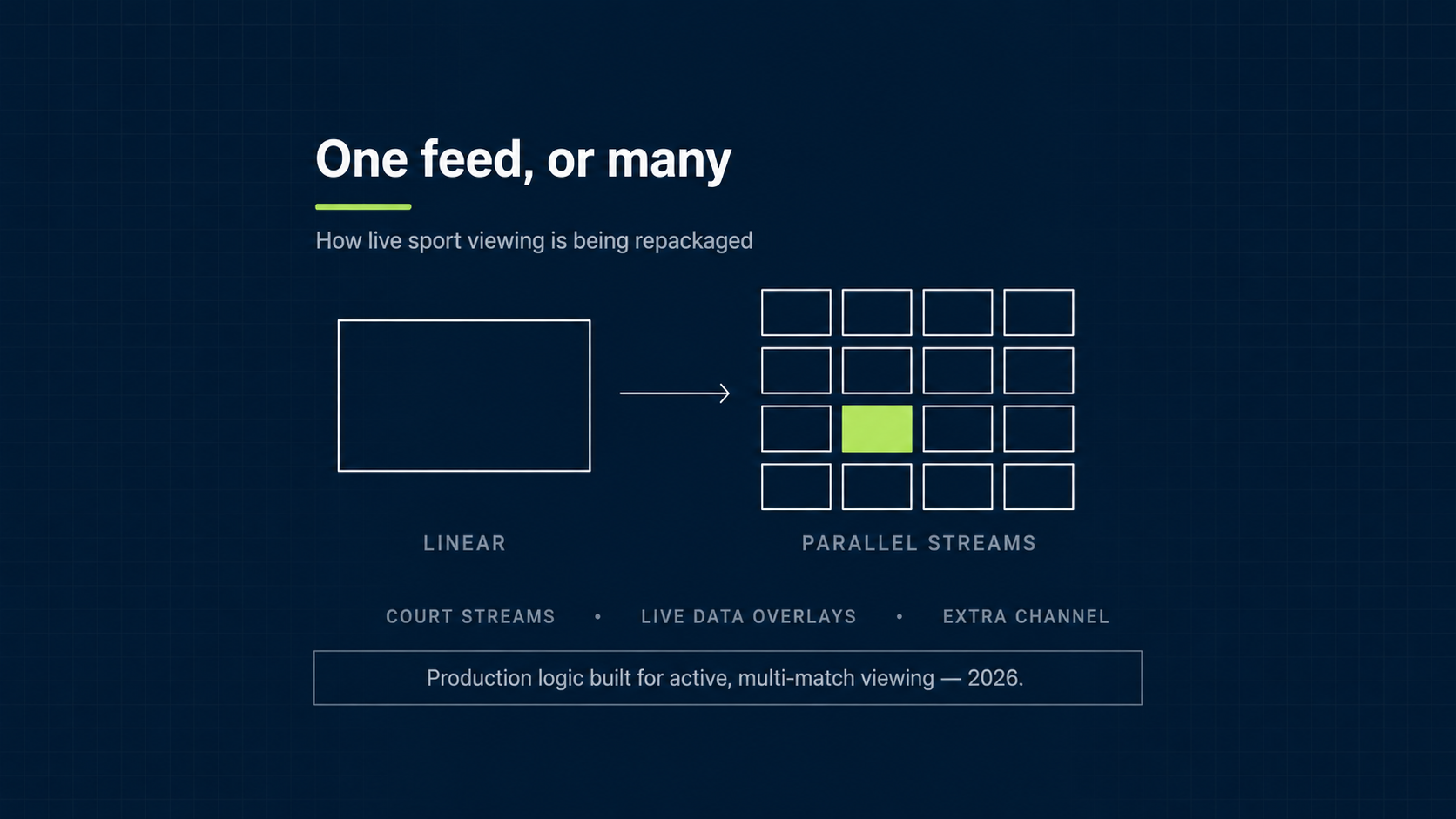
Under the renewed agreement between the BBC and the All England Lawn Tennis Club — which extends the tournament's presence on BBC platforms until 2033 — every match from all 18 courts is now available to UK audiences via BBC iPlayer and BBC Sport online, alongside daily linear coverage. The iPlayer layer includes individual court streams through Wimbledon Extra, live data overlays featuring serve speeds, in-match statistics, turning points and an interactive quiz feature, and a hybrid production model combining output from Salford and London. SVG Europe, covering the technical delivery, describes the BBC's approach as an evolution in how Wimbledon is packaged for streaming audiences — more graphical support, more digital editorial features, greater capability for viewers who move between courts rather than follow a single linear feed.
This is not a production built from scratch for a new audience. It is an evolution of a long-standing relationship, applied at greater scale and with greater digital investment. The distinction matters for how the model should be read by the broader sport broadcast industry.
What the Evolved Production Model Involves
The technical architecture behind the 2026 iPlayer offering, as reported by SVG Europe, involves multi-feed delivery across individual court streams, data overlay integration through the Signals feature — an L-shaped graphical element providing live stats and contextual information — and a production workflow designed around the streaming consumption pattern rather than adapted from a linear output. The Salford/London hybrid production model reflects how BBC Sport has distributed its major event production infrastructure.
Voice Sport editorial reading: this points toward a production logic designed for parallel, active viewing rather than only linear scheduling. Viewers watching on iPlayer can switch courts, engage with data layers, and move between matches in ways that a passive television viewer would not seek out. Designing the editorial and technical package to serve that behaviour — rather than treating it as a secondary use case — represents a meaningful shift in production priority, even if SVG Europe characterises it as evolution rather than revolution.
Multi-feed architecture at this scale requires the production to simultaneously manage multiple match feeds, each with its own data integration, at a quality level sufficient for primary viewing. That is technically demanding and implies a production investment that goes well beyond adding camera coverage to the outer courts.
The Rights Extension: Access and the Listed-Events Context
For UK audiences, the most immediately visible element of the 2026 arrangement is the completeness of the all-court digital offering. Wimbledon has had some level of digital multi-court availability in previous years via iPlayer; the 2026 model represents a more fully developed version of that proposition, with Wimbledon Extra and the full suite of 18 individual court streams integrated into a coherent BBC Sport digital experience.
The listed-events context is relevant here. Under Ofcom's UK framework, Wimbledon's free-to-air protection is differentiated: Wimbledon finals are a Group A listed event, requiring live coverage on a free-to-air channel available to the whole UK population; non-finals play is Group B, requiring secondary coverage rights to be offered to free-to-air broadcasters. The practical implication is that the free-to-air guarantee for non-finals play — including most of the all-court iPlayer content — operates under different regulatory conditions than the finals coverage.
This distinction does not diminish the value of the all-court iPlayer proposition, but it is relevant to how the "free-to-air" framing should be used. For the BBC, building Wimbledon Extra and the all-court streaming model on iPlayer — a service free to access — addresses the spirit of the access debate while operating within the technical framework of how BBC digital services are defined relative to traditional broadcasting.
The commercial logic for the AELTC is about maintaining Wimbledon's position as a mass-audience event. All-court coverage on iPlayer addresses the risk of the tournament becoming a niche product watched by a shrinking linear audience rather than a national summer event accessible to everyone who wants it. For the BBC, the extended deal reinforces iPlayer as the home of major live sport at a moment when the corporation is navigating its future funding model.
The Production Model as a Reference Point
For sport rights executives and event owners watching the AELTC/BBC arrangement, the production architecture dimension of this deal is arguably more instructive than the rights extension itself.
The expansion of all-court digital coverage is a decision specific to Wimbledon's context: its protected status, its long-standing BBC relationship, and the AELTC's established priorities around public access and brand positioning. Other events, in different rights environments and with different commercial structures, cannot simply adopt the same access model.
But the approach to iPlayer-layer production — multi-feed delivery, data overlay integration, editorial features designed for active viewers who move between matches — is a technology and audience positioning decision that is separable from the specific rights arrangement. Any major event owner can invest in these capabilities, regardless of whether their rights sit with a public service broadcaster, a subscription platform, or a streaming-only service.
The argument for making that investment is audience-driven. The consumption patterns of sport audiences — particularly for younger demographics and for events with large draws spread across multiple simultaneous matches — are increasingly shaped by the streaming environment. An event that builds a digital layer capable of serving that behaviour, rather than simply repurposing linear content online, is positioning for where the audience is.
What the Relationship Model Reveals
One element of the AELTC/BBC arrangement worth noting beyond the technology is the nature of the relationship itself. The BBC and Wimbledon have a partnership that predates the modern sport rights market by decades. The degree of institutional knowledge and shared operational experience between the two organisations is not replicable through a competitive rights auction.
That relationship has created the conditions under which both parties could commit to a more ambitious digital production model — one that requires significant investment and carries real technical and editorial execution risk. A broadcaster entering a rights relationship through a competitive tender, with a fixed contract period and limited embedded knowledge, is less likely to make the same kind of digital-layer infrastructure commitment.
For event owners considering how to structure rights relationships, the AELTC/BBC model suggests that the production innovation enabled by long-term partnership continuity may not be fully captured by a rights maximisation approach. That is not an argument against competitive tendering; it is an argument for understanding what is being traded when continuity is sacrificed for short-term value.
What the Data Will Show
The test of the 2026 model is in the audience data. Whether all-court streaming coverage on iPlayer grows the Wimbledon audience, deepens engagement with the tournament, and demonstrates production quality that justifies the investment will be visible in the consumption figures that follow the fortnight.
For the sport broadcast industry, Wimbledon 2026 is a high-profile data point for the iPlayer-led, all-court streaming model. If the data supports the investment, it strengthens the case for other major events to evolve their digital production layers. If the data is ambiguous, it will prompt the industry to ask harder questions about what active, multi-feed streaming requires in terms of audience education and platform design — not just production ambition.
Sources
- Wimbledon/AELTC, "All England Club and BBC extend historic Wimbledon partnership." wimbledon.com/en_GB/news/bbc-and-all-england-club-extend-historic-wimbledon-partnership-u
- Ofcom, "Approved application: Wimbledon Championships 2026." ofcom.org.uk/cy/tv-radio-and-on-demand/listed-sporting-events/approved-application-wimbledon-championships-2026
- SVG Europe, "Wimbledon 2026: Bringing strawberries and the cream of tennis from the AELTC to BBC Sport viewers." svgeurope.org/blog/headlines/wimbledon-2026-bringing-strawberries-and-the-cream-of-tennis-from-the-aeltc-to-bbc-sport-viewers/
- SVG Europe, "BBC to expand Wimbledon coverage with interactive data overlays and new talent." svgeurope.org/blog/headlines/bbc-to-expand-wimbledon-coverage-with-interactive-data-overlays-and-new-talent/