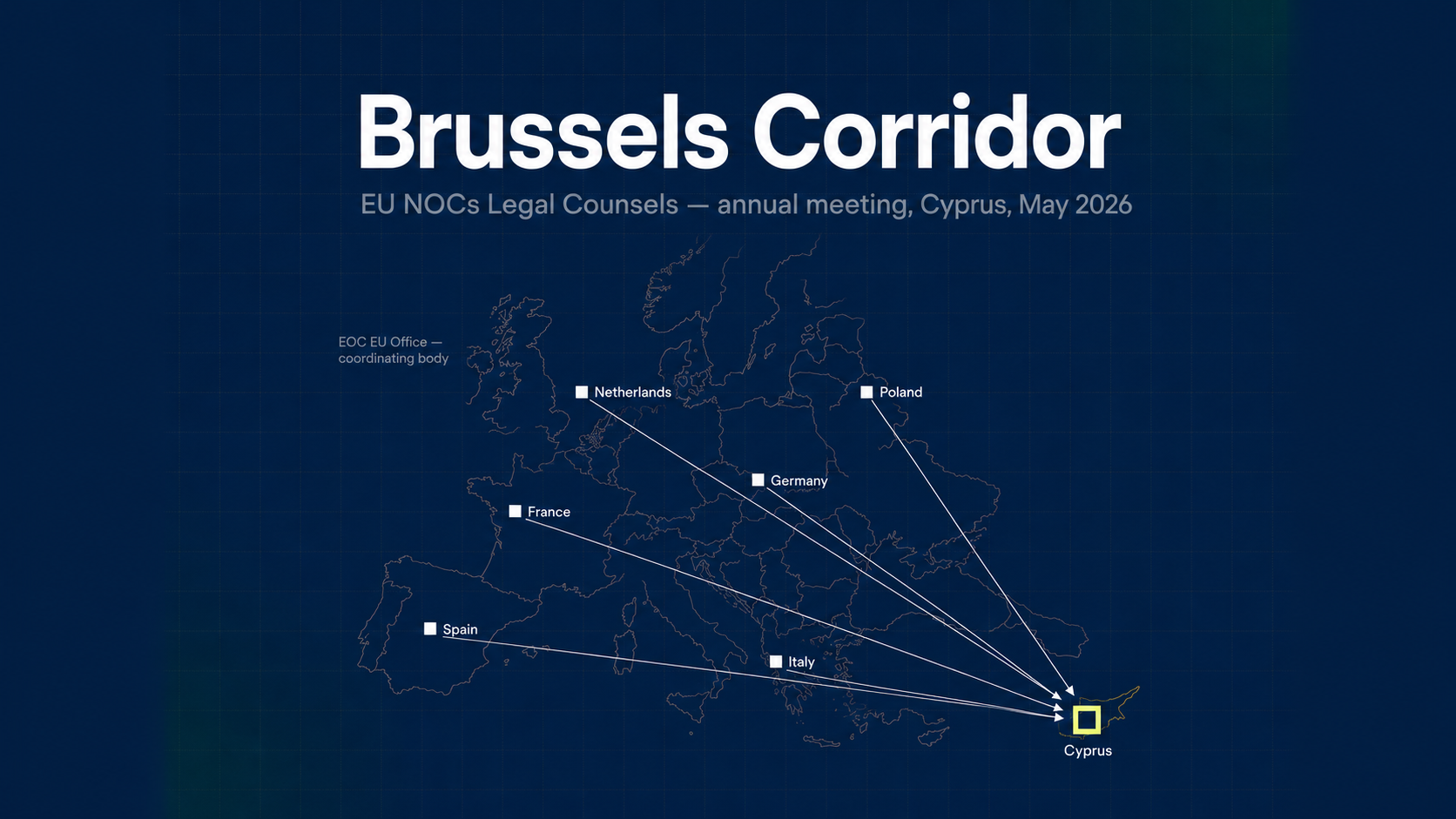
Legal experts from National Olympic Committees across the EU met in Cyprus in the week of 11 May 2026 for the annual meeting of the EU NOCs Legal Counsels, per the EOC EU Office in Brussels. This follows the third annual exchange held in Split, Croatia, hosted by the Croatian Olympic Committee and reported by the EOC EU Office in April 2025. The format is one of the low-visibility, high-substance institutional files in European Olympic Movement coordination — the kind of dialogue that does not usually produce detailed public minutes or granular policy outputs, but shapes how EU sport regulation lands at NOC level.
What the EU NOCs Legal Counsels actually is
The EU NOCs Legal Counsels is the annual exchange of legal experts representing National Olympic Committees in EU Member States. Per EOC EU Office reporting, legal experts from EU NOCs convene each year; the EOC EU Office in Brussels coordinates the format and publishes updates from it.
Per the EOC EU Office's published account of the Cyprus session, the meeting reinforced dialogue and cooperation within the European Olympic Movement, with an Office update on recent EU developments and the evolving case law of relevance to the Olympic Movement. The Cyprus meeting also covered athletes' rights, esports governance, ethical considerations in sports development, the field of play doctrine, and the role of the CAS Ad Hoc Division, according to the EOC EU Office. No detailed agenda or minutes beyond these high-level descriptions are publicly available.
Public reporting from earlier editions sets the broader scope of what these meetings typically cover. Per the EOC EU Office's coverage of the third annual exchange in Split (reported April 2025), discussions there centred on esports, safe sport, arbitration and public scrutiny. The shared frame across editions is the operational interpretation of EU rules and recent case law as they affect Olympic-sport delivery in Member States.
Substantive content from any specific meeting beyond these high-level descriptions is not publicly disclosed. Outputs typically take the form of internal alignment among EU NOC legal teams rather than detailed public statements.
Why the EOC EU Office is the coordinating body
The European Olympic Committees (EOC) is the umbrella body for National Olympic Committees in Europe. The EOC EU Office in Brussels is the EOC's permanent liaison office to EU institutions, handling the interface between European Olympic Movement bodies and EU sport-policy formation in Brussels.
The EU Office is positioned to coordinate the Legal Counsels format because:
- Brussels location — direct access to EU institutional contacts and Brussels-based expert resources
- Cross-NOC coordination mandate — the EU Office is positioned to coordinate EU Member State NOCs without favouring any single national federation's framing
- Continuity — the EU Office maintains institutional memory across multiple Council Presidencies, Commission cycles and IOC reform cycles
- Brussels-based liaison pattern — the EOC and other European sport-governance bodies maintain Brussels-based liaison capacity for the same reason
Why Cyprus as venue
Cyprus also holds the Council of the EU Presidency from 1 January to 30 June 2026, per the Cyprus Presidency programme published on consilium.europa.eu. The timing gives the meeting a relevant Council Presidency backdrop, placing it in the capital that is currently chairing Council formations. The EOC EU Office release, however, does not state that the venue was selected because of the Presidency; the link between the two is contextual, not stated.
The rotating-venue pattern across NOC events is itself an institutional discipline. Smaller-NOC venues have hosted increasingly important meetings in recent years; the Split 2025 edition (hosted by the Croatian Olympic Committee, per EOC EU Office reporting) fits that pattern, with the Cyprus 2026 edition continuing it.
For Cyprus specifically: - Cyprus's Council Presidency period ends 30 June 2026; the Irish Presidency takes over 1 July 2026, per the Council Presidency rotation - The Cyprus NOC's positioning in the European Olympic Movement is structurally smaller than larger-EU-Member-State NOCs but maintains consistent engagement with the EU Office
What this means for European sport-business stakeholders
Three practical reads emerge.
Federations and sport-business stakeholders. The exchange can inform broader EU sport-policy dialogue and EOC EU Office representations on behalf of EU NOCs. National federations engaging EU NOCs on operational questions (sponsor coordination, athlete contracts, broadcasting-rights distribution) should expect Member State NOC legal teams to be aligned on recent case-law developments and the topics that the Cyprus exchange covered (athletes' rights, esports governance, ethical considerations, field of play doctrine, CAS Ad Hoc Division).
EU sport-policy planners. The institutional file is durable. The EU NOCs Legal Counsels annual exchange has now reached at least its fourth iteration; the dialogue may inform broader EOC EU Office representations, NOC-level alignment and future EU sport-policy engagement.
International federation stakeholders. International federations operating at the IOC and Olympic Movement level should treat EU NOCs Legal Counsels coordination as a parallel-track input to their own legal-coordination cycles. EU NOC-level positions and IOC-level positions can be shaped by different institutional contexts, and the EOC EU Office's coordination function is part of what makes that EU-level reading visible.
What is uncertain
The substantive content of this specific meeting is not publicly disclosed beyond the high-level topic list (recent EU developments, case law of relevance to the Olympic Movement, athletes' rights, esports governance, ethical considerations in sports development, the field of play doctrine, and the role of the CAS Ad Hoc Division). There is no public granular agenda or minutes. Public reporting on prior editions (Split: esports, safe sport, arbitration, public scrutiny) sets the typical scope but is not a substitute for primary disclosure of the Cyprus agenda. The precise event date inside the week of 11 May 2026 is also not specified in the EOC EU Office's published account.
Forward look
Three watch items:
- EOC EU Office public outputs in the next 60 days — any policy paper, Council consultation response, or Commission-facing letter that may reflect alignment discussed at the Cyprus meeting
- European Olympic Movement positions on broader institutional files (athlete voice; Russian and Belarusian athlete participation; EU competition-law sport applications; esports governance; CAS Ad Hoc Division engagement) — looking for coordinated EU NOC framing
- The next annual exchange venue in 2027 — a signal of which Member State NOC is positioning for greater coordination visibility, with the Irish Presidency (H2 2026) and the incoming Ireland-Lithuania-Greece trio providing the political context
The reasonable read of the Cyprus meeting is that European Olympic Movement legal coordination is mature institutional infrastructure, not a one-off file. The reasonable editorial read is to track post-meeting positions in the months following, not the meeting itself.
Sources
- EOC EU Office — EU NOCs Legal Counsels annual meeting in Cyprus (May 2026)
- EOC EU Office — Legal Counsels of EU NOCs meet in Split for third Annual Exchange (April 2025)
- European Olympic Committees newsroom (eurolympic.org/news/)
- Cyprus Presidency of the Council of the EU 2026 (cyprus-presidency.consilium.europa.eu)