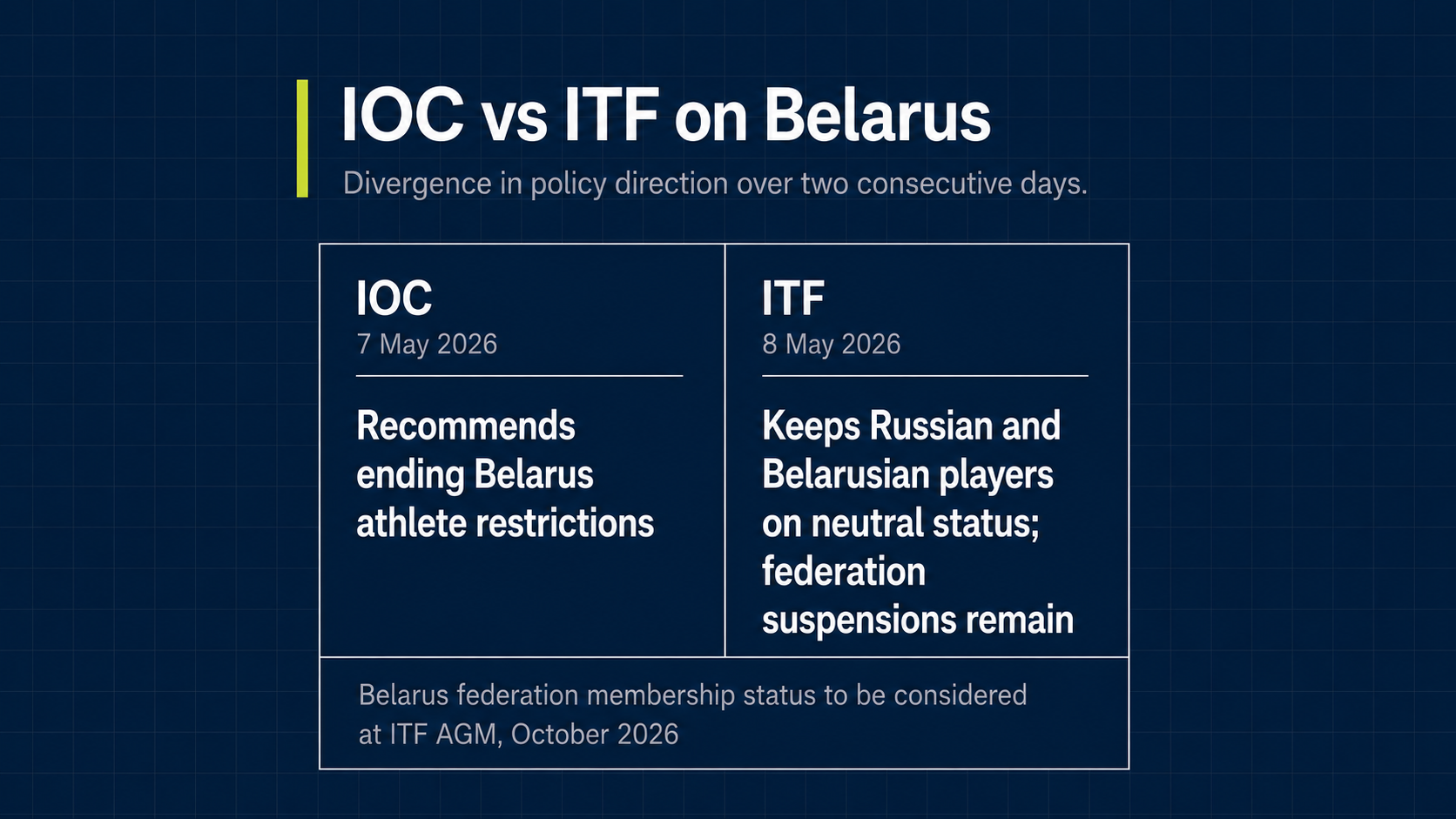
The International Tennis Federation confirmed on 8 May 2026 that it will keep Russian and Belarusian tennis players competing as neutral athletes in ITF-governed competition contexts where the existing neutral-athlete and federation-suspension framework applies. The statement arrived one day after the IOC Executive Board's 7 May recommendation that International Federations and international sports event organisers no longer apply restrictions on the participation of Belarusian athletes. It is one of the clearest public divergences between IOC guidance and an international federation rule-set in the post-Paris 2024 cycle.
What changed and what did not
Two distinctions matter. The ITF's existing position is unchanged: Russian and Belarusian players have competed under neutral status since 2022, and the 8 May statement reaffirms that framework. The Belarus and Russian Tennis Federations' federation-level suspensions also remain in place. What changed is the IOC's recommendation: on 7 May, the IOC Executive Board lifted the recommended conditions of participation it had previously set out (28 February 2022 and 28 March 2023) as they relate to Belarus and Belarusian athletes, including the protective measures, per the IOC newsroom. The IOC framed the change as no longer recommending restrictions on Belarusian athlete participation in competitions governed by International Federations and event organisers. Russian athletes remain on the IOC's separate suspension framework.
The ITF declined to act on the IOC's recommendation for its own sanctioned events. The membership status of the Belarus Tennis Federation is scheduled for consideration at the ITF Annual General Meeting in October 2026 by the federation's voting member nations.
For European tennis federations, this is the operational situation:
- At ITF events (Davis Cup, Billie Jean King Cup, Grand Slam qualifying where ITF rules apply, lower-tier ITF World Tennis Tour events): Russian and Belarusian players continue as neutrals; both federations remain suspended from team competition
- At ATP and WTA events (the men's and women's professional tours): tour-specific rules apply; ATP and WTA have not changed their own positions
- At Olympic qualification events: the applicable framework will depend on the sport-specific qualification system, the relevant federation rules and any IOC Games-time eligibility conditions
Daniil Medvedev, currently inside the ATP top ten, and Aryna Sabalenka, world number one on the WTA Tour, continue to play under neutral status. Neither player has been a decision-maker in the federation-level process; the relevance here is their on-court neutral status, not their personal position on the IOC recommendation.
Why the divergence is structurally significant
The IOC and the international federations operate on different rule-sets, on different reform clocks, and against different stakeholder pressures.
The IOC's authority is over Olympic-eligibility questions — who can compete at the Olympic Games, under what national or neutral identification, in what events. The IOC sets the framework for Games-time participation; the federations interpret and operationalise eligibility for their own circuits and qualification pathways.
International federations such as the ITF have their own constitutional authority over event participation outside Games-time. ITF events are not Olympic events; the ITF's eligibility framework is its own. An IOC Executive Board recommendation is not binding on federation rules, and the 7 May text was framed as a recommendation, not a directive.
The 8 May ITF statement sits alongside a wider pattern of differentiated federation responses. World Athletics has excluded athletes and officials from Russia and Belarus from its international events since 2022, and has confirmed that the IOC's 7 May move does not change that position. World Aquatics has moved in the opposite direction, with athletes from both countries returning to compete under national flags, anthems and uniforms following its 13 April 2026 decision. World Athletics, the ITF and World Aquatics are now three publicly different operational positions across major Olympic-event federations. The EOC and European NOCs remain a relevant follow-up layer for any European multi-sport event participation questions.
The European Olympic Movement context
The European Olympic Movement is not monolithic on this question. Different bodies, different rule-sets, different reform clocks:
- IOC: 7 May 2026 Executive Board recommendation to end Belarus athlete restrictions; Olympic-eligibility framework
- EOC (European Olympic Committees): a relevant follow-up layer for European multi-sport event participation questions
- National Olympic Committees: 27 EU NOCs plus European non-EU NOCs, each operating under national legislation that may constrain participation independently of IOC guidance
- International Federations (ITF, World Athletics, World Aquatics, and others): each with its own eligibility framework
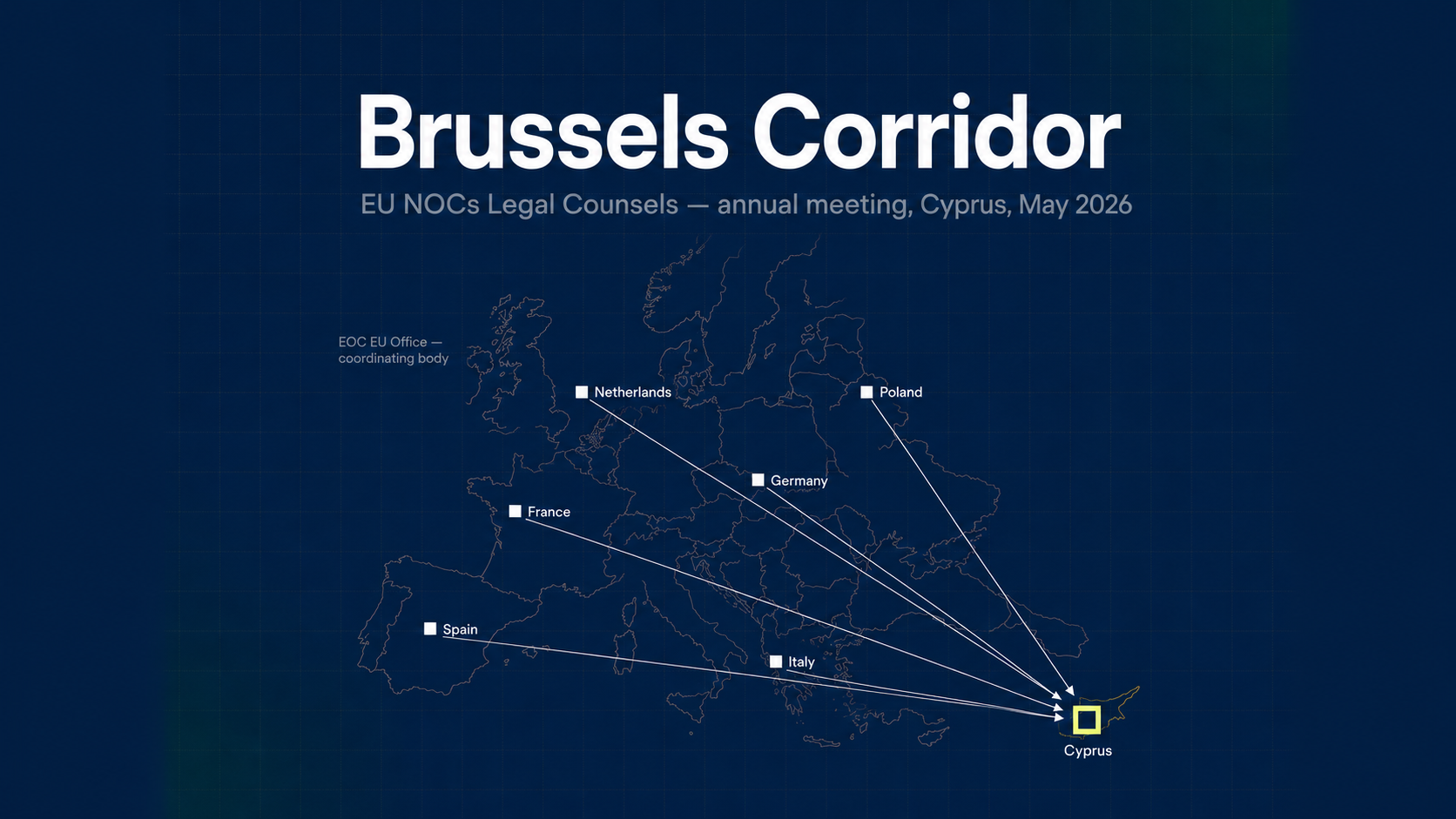
The EU NOCs Legal Counsels annual meeting in Cyprus in the week of 11 May 2026 (covered separately in W21) sits in the broader European Olympic Movement coordination cycle, and the Cyprus agenda included athletes' rights, esports governance, ethical considerations in sports development, the field of play doctrine and the role of the CAS Ad Hoc Division. The ITF position is one input to that wider European coordination architecture.
What this means for European tennis federations and players
The practical effect for European tennis federations and the players they license is limited in the near term. Russian and Belarusian players continue to compete on the existing neutral framework at ITF events; tour-level rules at ATP and WTA events have not changed; Olympic qualification pathways for the Los Angeles 2028 cycle will be settled closer to the qualification windows.
For European tennis players competing alongside Russian and Belarusian neutral athletes, the operational rules remain consistent: prize-money and ranking points awarded normally, no flags or anthems at ITF events, no commercial sponsorship references to Russian or Belarusian state-owned entities.
For European tennis-business stakeholders — federations, broadcasters, sponsors, tournament organisers — the structural read is that the federation-level rule-set is the operational rule-set. IOC guidance is the framework for Olympic-time questions; ITF discipline is the framework for ITF-sanctioned events.
What is uncertain
Whether further major Olympic-event federations will move in line with the IOC's 7 May recommendation, hold their existing positions, or move in the opposite direction (as World Aquatics has) is the open question for the next 60 days. FIFA has its own framework on Russian and Belarusian football participation. The EOC and European NOCs are a relevant follow-up layer for any European multi-sport event participation questions.
The October 2026 ITF Annual General Meeting consideration of Belarus Tennis Federation membership status is the next dated ITF institutional milestone. The ITF statement of 8 May does not predict either the AGM outcome or other federations' positions.
Forward look
Three watch items:
- Other federation positions in response to the IOC 7 May recommendation: FIFA, World Rowing and the remaining major Olympic-event federations yet to comment publicly
- EOC and European NOC positioning on European multi-sport event participation, particularly any European Games or continental qualifier in the Los Angeles 2028 cycle
- ITF AGM, October 2026: the scheduled consideration of Belarus Tennis Federation membership status by the ITF's voting member nations
The reasonable read of 8 May is that the European Olympic Movement is operating on a multi-stream rule-set, with the ITF having chosen to keep its existing position while the IOC and World Aquatics have moved in different directions. The reasonable editorial read is to track the federation-level positions alongside the IOC headlines, because the federation rule-sets are what govern athletes' weekly competition reality.
Sources
- International Tennis Federation — ITF confirms position on Belarus and Russian Tennis Federations (8 May 2026)
- International Olympic Committee newsroom — IOC no longer recommends restrictions on Belarusian athletes' participation (7 May 2026)
- World Athletics public response to the IOC 7 May recommendation (May 2026)
- World Aquatics — decision permitting athletes from Russia and Belarus to compete under national flags, anthems and uniforms (13 April 2026)