This article continues a previous Voice Sport analysis of the Balogun suspension and UEFA's response. If you have not read that piece, start there.
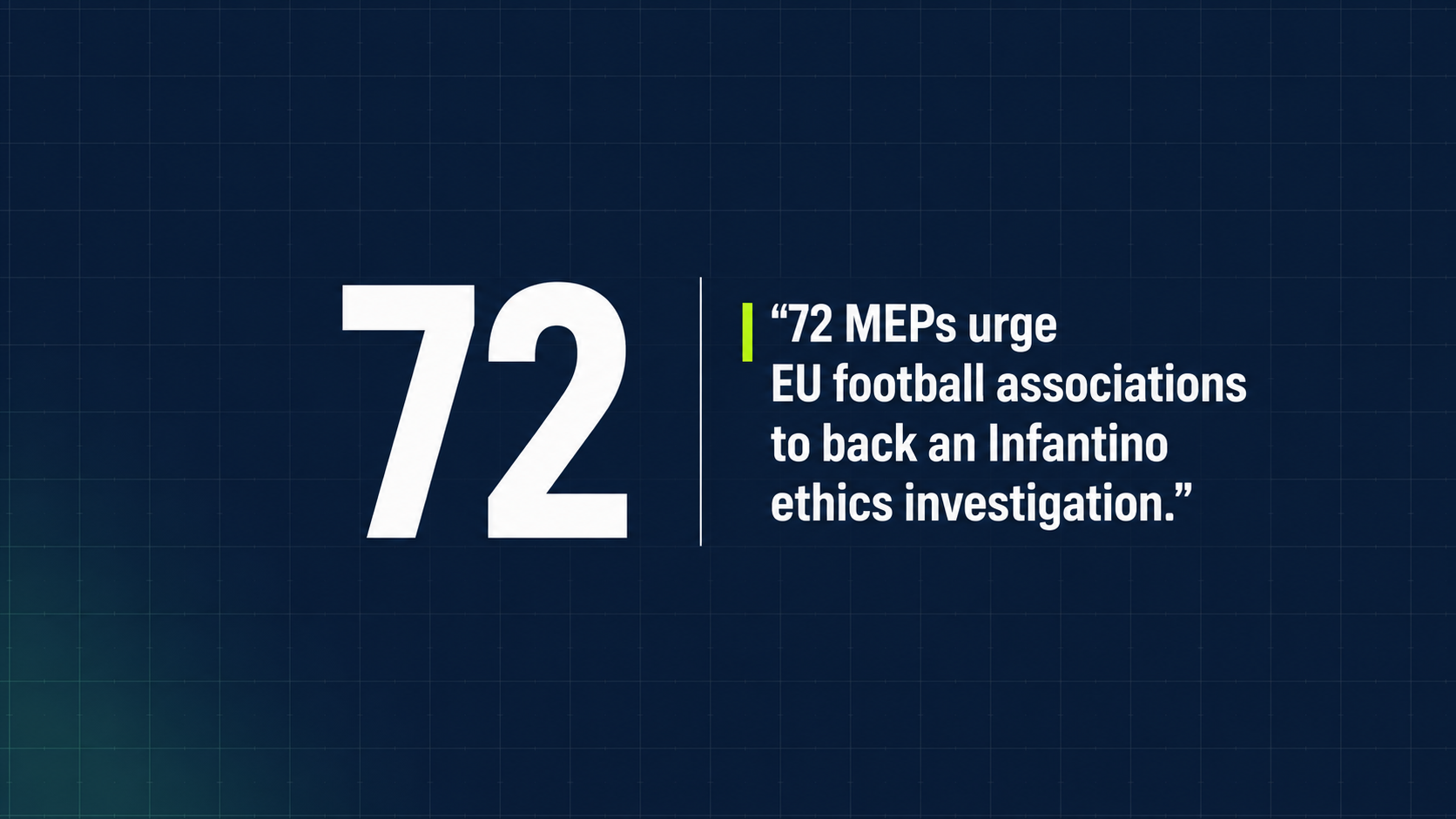
On 8 July 2026, 72 members of the European Parliament signed and published a letter. Its destination was not Zurich, and it was not addressed to FIFA directly. It was addressed to the national football associations of European Union member states.
The routing of that letter is one of the more interesting details in this story, though not for the reason it might first appear.
---
Why the Letter Went to National Associations, Not to FIFA
FIFA is not an EU institution. It is a private, non-governmental international organisation headquartered in Switzerland. The European Parliament has no direct legal authority over FIFA, no enforcement mechanism, and no jurisdiction over how FIFA disciplines players, appoints officials, or governs its own internal processes.
The 72 MEPs who signed this letter wrote to the national associations, the 27 EU member states' football federations that are also FIFA members, rather than to FIFA itself. That choice reflects where institutional leverage over FIFA actually sits: with its own member federations, not with outside political bodies.
It is worth being precise about what that channel is, and is not. Under FIFA's Code of Ethics, any person may submit a written complaint about a potential breach of the Code, and the chairperson of the Ethics Committee's investigatory chamber may also open a preliminary investigation on their own initiative, without waiting for a complaint from anyone. National associations are not a mandatory gateway to an Ethics Committee investigation, and there is no defined threshold of associations required to make a review happen. What the MEPs did was choose to address the actors with the most institutional and political weight inside FIFA's own governance structure, rather than the only actors capable of raising the concern.
That is a meaningful distinction. The letter is not activating a procedural mechanism that would otherwise sit dormant. It is adding institutional weight to a concern that could, in principle, be raised by anyone, including individuals or organisations with no FIFA membership status at all. A UK-based rights group, FairSquare, had already raised the Peace Prize and its political-neutrality implications with FIFA's Ethics Committee in December 2025, and FIFA confirmed it had received that complaint; per Reuters, FairSquare has also pursued a related complaint concerning Infantino with the IOC. The Balogun case did not create the pathway to FIFA's Ethics Committee. It added a second, larger, and more institutionally prominent voice to a channel that was already open.
---
What the Letter Covers
The 72 MEPs raised concerns in their letter to the national associations.
The first is the Balogun suspension. Following the red card shown to USMNT striker Folarin Balogun on 1 July, and the subsequent documented phone call between President Trump and FIFA President Infantino, FIFA's Disciplinary Committee invoked Article 27 of its Disciplinary Code to suspend the implementation of the automatic one-match ban for a one-year probationary period. The letter asks for scrutiny of that decision-making process, including whether pressure connected to the Trump call played any role, and whether Infantino's conduct during and after the call is consistent with FIFA's political-neutrality obligations under Article 15 of its Code of Ethics.
The second concern is the FIFA Peace Prize. FIFA created the award in 2025, intended to be presented annually, and its inaugural edition went to President Trump. The letter asks whether the creation and presentation of that prize, to a sitting head of state who had also asked FIFA's president to review a disciplinary case, raises the same political-neutrality question.
Beyond these two specific episodes, the letter refers more broadly to potential breaches of FIFA's political-neutrality obligations. Reporting on the letter has not specified a distinct, named third allegation beyond the two above; that broader reference is best read as a general call for scrutiny rather than as an additional, undisclosed claim.
---
Why the Ethics Committee Matters
The FIFA Ethics Committee is FIFA's primary internal accountability mechanism for conduct-related investigations involving officials and functionaries, including the FIFA President. Its independence from the FIFA executive has been a recurring subject of debate, and its operational record is mixed: it has acted decisively in some cases and been criticised for inaction in others.
Whether the Ethics Committee opens a fresh investigation connected to this letter, and whether individual national associations choose to add their own institutional weight to the request, are open questions. No association had publicly confirmed a position as of the time of writing.
What the letter does, regardless of the answer to those questions, is put a documented, 72-signature request into the public record, alongside FairSquare's pre-existing complaint. That creates political and reputational pressure on the associations that received it, and on FIFA. It does not, on its own, legally compel either the associations or the Ethics Committee to open or expand proceedings.
---
The European Dimension
This episode is unfolding at a moment when European lawmakers and European sport governance bodies are in a period of heightened mutual attention. The European Parliament has, over the past five years, become significantly more engaged with sport governance questions, through its work on the European Sport Model, its input into the EU Sport Forum, and its scrutiny of how major governing bodies handle financial transparency, athlete rights, and competition law.
Political neutrality is not merely an internal FIFA rule. It is, in a broad sense, part of the backdrop against which European public funding flows to sport, public broadcasters justify rights investments, and governments consider co-hosting major events. A FIFA whose documented decisions raise questions about political neutrality, however those questions are ultimately resolved, is a FIFA that poses a governance consideration for European partner institutions engaged in those funding, rights, and hosting decisions.
The MEPs are not the only European actors with this concern. UEFA's public statement describing the Balogun decision as having "crossed a red line" preceded the letter by roughly two days. The two responses are connected: one from a sport institution, one from a group of political actors, both converging on the same underlying question through their own respective channels.
---
The National Association Question
The national football associations who received the MEPs' letter now face a choice that is simultaneously political and institutional, but it is not the binary "trigger or don't trigger" choice it can appear to be.
Voice Sport editorial reading: if associations choose to add their institutional voice, whether through a formal submission or a public statement of support, that strengthens the pressure on FIFA's Ethics Committee to be seen to respond, without changing the underlying legal position that any person can already raise a complaint. If they stay silent, the letter and FairSquare's complaint remain in the public record as documented requests without an additional institutional endorsement from FIFA's own members. Either way, FIFA's existing legal obligation is only to process complaints already before it; this letter does not create a new procedural obligation.
For European sport executives watching this, the more informative signal is not whether a formal "trigger" event occurs, since the letter does not describe one, but whether national associations, who have their own institutional relationship with FIFA to protect, choose to publicly align themselves with the MEPs' concern.
---
What This Means for European Sport Governance
The Balogun episode, the disciplinary decision, UEFA's statement, the MEPs' letter, is unlikely, on its own, to result in a fundamental restructuring of FIFA's governance. Institutional systems of this scale do not change rapidly in response to single incidents.
Voice Sport editorial reading: what it may do is recalibrate how European sport institutions, confederations, national associations, leagues, and the legislators who interact with them, read FIFA's political-neutrality commitment in practice, and how much weight federations are willing to put behind ethics complaints once they are already in the public record. Rights negotiations, event co-hosting decisions, and public funding allocations all involve some assessment of the governance reliability of the counterparty institution; this episode is one input into that assessment, not a resolved verdict on it.
The letter from 72 MEPs, alongside FairSquare's pre-existing complaint, is one data point in an accumulating body of evidence about how FIFA manages the intersection of politics and governance.
---
Sources
Primary sources: - Letter from 72 Members of the European Parliament to the national football associations of EU member states, 8 July 2026. - FIFA Code of Ethics, Articles 15 (political neutrality), 60 (right of any person to report a potential breach) and 61 (investigatory chamber's power to open proceedings on its own initiative). - Reuters, "Rights group plans complaint to IOC against Infantino over Trump support," 8 July 2026. reuters.com/sports/soccer/rights-group-plans-complaint-ioc-against-infantino-over-trump-support-2026-07-08/ - Time, reporting on the 8 July letter and the growth in signatories from 35 to 72. time.com/article/2026/07/10/world-cup-fifa-infantino-trump-us-balogun-red-card-european-lawmakers/ - Inside FIFA, "President Donald J. Trump awarded 'FIFA Peace Prize – Football Unites the World.'" inside.fifa.com/campaigns/football-unites-the-world/news/president-trump-peace-prize-football-unites-the-world
Institutional reporting: Al Jazeera, Yahoo Sports, GiveMeSport, Washington Post, KingFut, reporting on the letter's content and signatory count.